Architectural Shingles vs. Metal Roofing in Coastal North Carolina
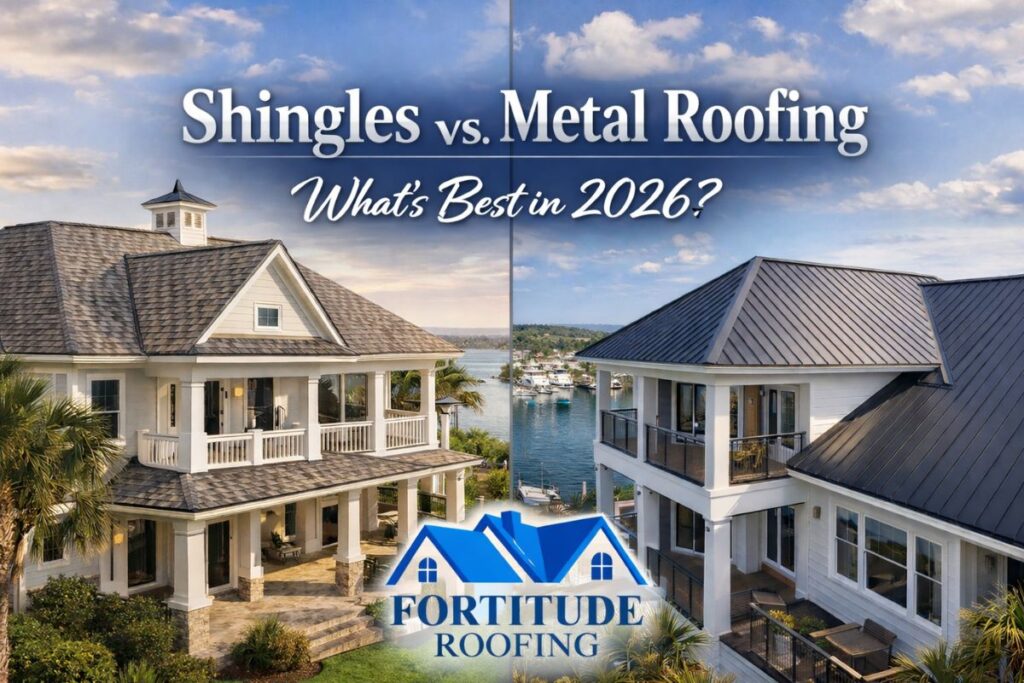
If you’re planning a roof replacement in 2026, you’re likely weighing two premium options: architectural shingles and metal roofing. Both can perform well in Eastern North Carolina—but they serve different ownership horizons, risk profiles, and budgets.
Fortitude Roofing installs architectural shingle and metal roof systems across Eastern North Carolina, including Wilmington, Hampstead, Leland, New Bern, Morehead City, Emerald Isle, Swansboro, and surrounding coastal communities. This guide breaks down the decision so you choose based on lifetime value and storm performance, not marketing claims.
Quick Answer: Which Roof Is Better in Coastal NC?
- Architectural shingles are typically the best fit if you want premium curb appeal and strong performance with a controlled upfront investment and simpler repair pathways after storms.
- Standing seam metal is typically the best fit if you want maximum durability, low maintenance, and stronger resilience in higher-wind and salt-exposure zones.
The right choice depends on exposure (wind + salt), roof geometry, insurance/underwriting constraints, and how long you plan to own the home.
The “Pick This If…” Decision Filter
Choose architectural shingles if:
- You want a premium look and solid performance at a lower upfront cost
- You expect to move in 5–12 years (often)
- You prefer repairs that are typically simpler and more widely serviceable
- Your exposure is moderate (not directly salt-exposed)
Choose standing seam metal if:
- You’re near salt exposure or in higher-wind corridors and want maximum durability
- You plan to own long-term (or you’re protecting a high-value property)
- You want minimal maintenance and long lifecycle economics
- You want a concealed-fastener system engineered for water management and uplift resistance
Important: “Metal Roofing” Is Not One Product
When homeowners say “metal roof,” they usually mean one of two categories:
- Standing seam (concealed fastener): premium, engineered system
- Exposed-fastener panels (screw-down): lower cost, different maintenance curve and long-term watertight behavior
This article compares architectural shingles vs. standing seam primarily, and flags exposed-fastener differences where relevant.
Why This Decision Matters More Going Into 2026
Coastal NC roofing decisions are shifting from “lowest bid” to “risk and lifecycle cost.” You’re seeing that shift in:
- Increased underwriting scrutiny of older roofs
- Homeowner demand for storm-resilient assemblies
- Grant/incentive programs tied to resilience standards (including IBHS FORTIFIED Roof programs for certain coastal policyholders, subject to eligibility and funding availability) (NC DOI)
Practical implication: your roof choice can affect maintenance curve, storm exposure risk, and long-term ownership cost, not just appearance.
Option 1: Architectural Shingles
Architectural (dimensional) shingles remain the most common “premium” choice in Eastern NC because they balance cost, aesthetics, and serviceability.
Advantages
- Lower upfront investment than standing seam metal
- Wide aesthetic range (coastal and traditional styles)
- Strong wind-rated options exist when installed to specification
- Repairs are typically easier and more commonly serviceable than metal
Coastal considerations
- Lifespan is highly exposure-dependent (heat/UV, ventilation performance, storm cycles, salt influence)
- More vulnerable to seal fatigue under repeated wind events than a well-executed standing seam assembly
- Real performance is driven by system details (edges, starter, flashing, underlayment, ventilation), not just shingle brand
Wind ratings: how to interpret them correctly
Wind resistance is often referenced using ASTM classifications:
- ASTM D3161 includes wind classifications up to Class F (commonly referenced as 110 mph test conditions). (ASTM International | ASTM)
- ASTM D7158 is commonly discussed by manufacturers as Class D (90), Class G (120), Class H (150). (ASTM International | ASTM)
Two clarifications that matter:
- These are controlled test-method classifications, not a promise your roof “handles a 150 mph hurricane.” (GAF)
- Field performance depends on the full assembly: deck attachment, nail placement/pattern, starter/edge details, ventilation, and exposure.
Option 2: Standing Seam Metal Roofing
Standing seam metal has gained traction in higher-exposure zones because it’s engineered as a durable, low-maintenance roof system with concealed fastening and strong water management.
Advantages
- High long-term service life potential when correctly specified and installed
- Excellent water management (vertical panels + raised seams)
- Lower routine maintenance relative to shingles
- Strong fit for homeowners prioritizing resilience and long-term economics
Considerations
- Higher upfront investment
- Specialized installation and detailing requirements (most “metal roof failures” are detail failures)
- Not every roof geometry is ideal; transitions and penetrations must be executed with discipline
Coastal reality: corrosion strategy is not optional
Near the coast, standing seam only performs as expected when specified for salt exposure: correct panel material/coating, compatible flashings, and corrosion-resistant accessories. This is a specification + detailing conversation—not just “metal vs shingles.”
Coastal-Spec Requirements That Decide Performance
Generic blogs argue “metal vs shingles.” Coastal NC outcomes are decided at edges, penetrations, and transitions.
Architectural shingles: performance drivers
- Starter strip and edge strategy (rakes/eaves/corners are uplift zones)
- Nail count/pattern and placement per manufacturer requirements
- Underlayment strategy appropriate for wind-driven rain
- High-integrity flashing at chimneys, walls, valleys, and penetrations
- Ventilation aligned to manufacturer requirements (not “whatever was there”)
Standing seam: performance drivers
- Seam type appropriate for slope/exposure (snap-lock vs mechanically seamed)
- Clip spacing and perimeter-zone reinforcement appropriate for uplift loads
- Terminations (eaves/rakes/ridges) executed for wind and water
- Penetrations flashed correctly (pipe boots, skylights, mechanicals)
- Coastal-appropriate material/coating selection and compatible accessories
Architectural Shingles vs. Standing Seam Metal in 2026
| Factor | Architectural Shingles | Standing Seam Metal |
| Upfront cost | Lower | Higher |
| Service life potential | Moderate–High (exposure-dependent) | High (exposure-dependent) |
| Wind performance | Strong options exist when installed to spec (Owens Corning) | Strong; system- and detailing-driven |
| Salt exposure | Can accelerate aging over time | Must be specified for coastal corrosion |
| Maintenance | Moderate over time | Minimal when detailed correctly |
| Repairability after storms | Often simpler spot repairs | Repairs can be more specialized/detail-driven |
| Best fit | Premium performance with controlled cost | Long ownership, higher exposure, lifetime value |
Note if you’re comparing bids: exposed-fastener metal is a different product class; do not compare it as equivalent to standing seam.
Local Guidance by Submarket in Eastern NC
Wilmington / Hampstead
Wind-driven rain and storm cycles make flashing quality, underlayment strategy, and edge detailing decisive—regardless of material.
Leland (coastal-adjacent)
Homes still see hurricane gusts; subtle uplift damage and insurance review friction are common. Proactive inspections prevent rushed decisions.
Morehead City / Emerald Isle / Carteret County coastal zones
Salt exposure and higher wind zones increase the value of coastal-spec detailing and long-life systems—especially for long-term owners.
FAQs: Architectural Shingles vs. Metal Roofing in Coastal NC
Which roof lasts longer in coastal North Carolina?
Standing seam generally has higher long-life potential when specified for coastal corrosion and installed correctly. Architectural shingle lifespan is more exposure-dependent and typically shorter in harsher coastal conditions.
Are architectural shingles “hurricane-rated”?
Many shingles carry ASTM wind classifications such as D3161 Class F and D7158 Class H (as commonly described by manufacturers). (ASTM International | ASTM)
Real-world performance depends on building the full system to specification—especially edges, ridges, and penetrations.
Is standing seam worth it if I may sell in 5 years?
If your roof condition creates underwriting or inspection friction, standing seam can reduce perceived downside. If you’re selling soon and the roof isn’t a negotiation risk, architectural shingles may be the more rational capital allocation.
What’s the biggest failure point on each system?
- Shingles: edges/rakes, seal fatigue, flashing/penetration failures (often worsened by repeated wind cycles)
- Standing seam: terminations and penetrations when executed poorly (most “metal failures” are detail failures)
Are there incentives for stronger roofs in coastal NC?
Some NC coastal policyholders (often tied to NCIUA/coastal programs) may be eligible for grants tied to IBHS FORTIFIED Roof upgrades, depending on location, policy type, and program funding windows. (NC DOI)
Why Fortitude Roofing
We build fewer roofs by design so we can control details, documentation, and accountability. Homeowners choose Fortitude Roofing for:
- Education-first, pressure-free consultations
- System-based scopes (not “just shingles”)
- Disciplined coastal detailing standards
- Proactive communication and clean execution
- Premium components across the roof assembly
Insurance eligibility and premium impacts vary by carrier and policy; our focus is building roof systems that meet or exceed manufacturer requirements and applicable code.
Schedule a Roof Replacement Consultation in Eastern North Carolina
If you’re evaluating architectural shingles vs. standing seam metal in Wilmington, Hampstead, Leland, New Bern, Morehead City, Emerald Isle, or Swansboro, schedule a consultation with Fortitude Roofing.
You’ll receive a clear recommendation based on your home, your ownership horizon, and your exposure realities—without a sales pitch.
One thought on “Architectural Shingles vs. Metal Roofing in Coastal North Carolina”
Comments are closed.
Purchasing medicine online is extremely handy.
You can order at any time without leaving your house.
Online drugstores allow you to quickly check costs and find the lowest deal.
zenegra nausea
The order is shipped directly to your door, cutting travel and hassle.
Plus, there is no need to wait in long lines at a local pharmacy.
For ongoing illnesses, automatic reorders ensure therapy hassle‑free.
Overall, online ordering for medicine saves your time and peace of mind.