Roofing Costs in North Carolina: What Actually Drives the Price Up or Down
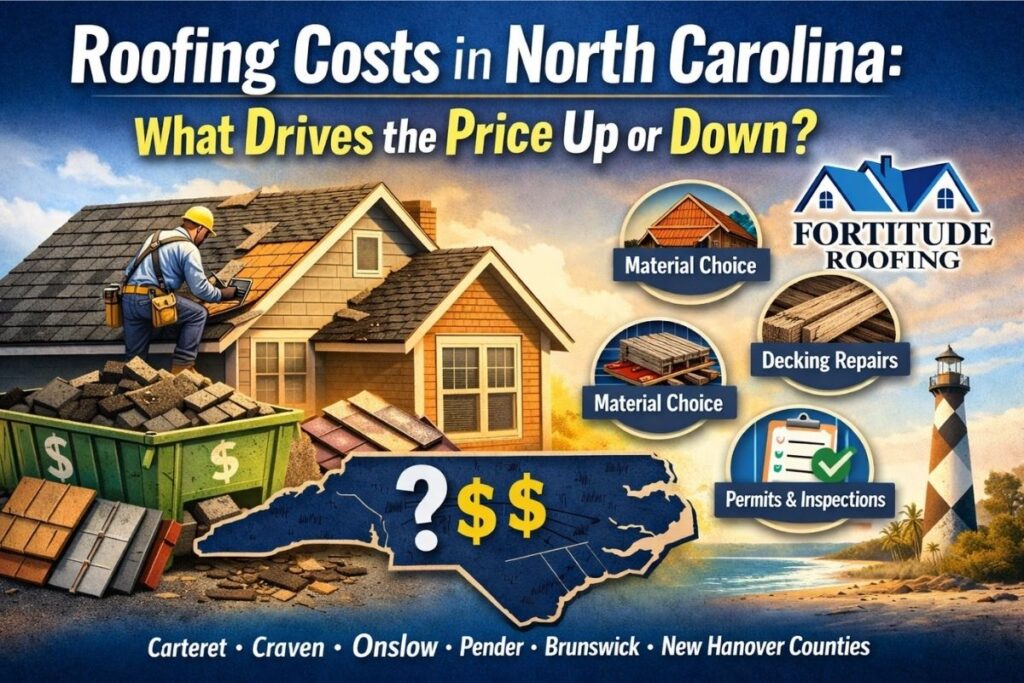
Roofing Costs in North Carolina: What Actually Drives the Price Up or Down
For homeowners in Carteret, Craven, Onslow, Pender, Brunswick, and New Hanover counties
Roofing costs are one of the least transparent parts of homeownership. Many homeowners receive wildly different estimates and are left unsure which numbers are reasonable—or why they vary so much.
This guide explains what actually determines roofing costs in North Carolina and how to evaluate pricing based on scope, risk, and long-term value (not just the headline number).
Quick Answer: What Drives Roofing Costs Most?
If you want the short list, these items typically move cost the most:
- Roof geometry and steepness (complexity and safety time)
- Material system (asphalt vs impact-resistant vs metal, etc.)
- Tear-off layers + disposal logistics (how much must be removed and hauled)
- Decking replacement (the most common “surprise” increase)
- Flashing and penetration work (where most leaks originate)
- Contractor process (supervision, quality control, insurance, warranty strength)
- Permits/inspections and code requirements (where applicable)
Why Roofing Prices Vary So Widely
Two roofs that look similar from the street can have very different costs because bids often differ on:
- what is included vs excluded (true scope vs vague scope)
- the material grade and system design (not just shingle color)
- how much risk the contractor is pricing in (decking, hidden damage, access constraints)
- the maturity of the contractor’s process (supervision, documentation, warranty follow-through)
Translation: pricing variation is usually scope and risk variation, not arbitrary markup.
The Biggest Factors That Influence Roofing Cost in North Carolina
1) Roof size and geometry
Square footage matters—but geometry often matters more.
Cost increases with:
- steep slopes (slower work, more safety requirements)
- multiple valleys/dormers (more cutting and high-risk detailing)
- skylights/chimneys/walls/penetrations (more flashing and leak-risk interfaces)
- complex ridge/hip layouts (more finishing time)
Simple roofs are fast and repeatable. Complex roofs are custom work.
2) Material selection and system performance
Material type and grade change both price and lifespan.
Common cost-impact choices include:
- basic asphalt vs architectural shingles
- impact-resistant shingles (material cost + system specs)
- metal systems (panel vs standing seam; trim complexity)
- specialty materials (tile, slate-style, premium synthetics)
Higher-cost systems can be rational when they buy down risk (wind, impact, long-term aging) rather than “upgrading for looks.”
3) Labor standards and installation control
Roofing is labor-intensive and safety-critical. Price differences often reflect:
- crew experience and speed without shortcuts
- on-site supervision (a real foreman vs “sales-only” model)
- fastening patterns and detailing discipline
- protection measures (landscaping, tarps, staging control)
Low bids rarely save money on materials. They usually save money on labor time and supervision.
4) Tear-off, layers, and disposal
Key questions:
- how many layers are being removed?
- how is debris handled (dump trailer vs repeated runs)?
- does access constrain staging (tight driveways, landscaping, fencing)?
Disposal can be a meaningful cost component, especially with multiple layers and heavy material.
5) Decking and structural repairs
In North Carolina—especially after storms—decking surprises are common.
If decking is compromised:
- it must be replaced to provide a solid fastening surface
- it increases materials and labor
- it can trigger schedule extensions
This is one of the top reasons “final cost” differs from “initial estimate.”
A professional estimate should clearly state:
- what decking is included (if any)
- unit pricing per sheet for additional decking
- how approvals happen (written change orders)
6) Flashing, penetrations, and leak-risk details
Most long-term roofing failures originate at:
- roof-to-wall transitions
- chimneys
- valleys
- pipe boots and vents
- edges and terminations
A legitimate estimate should specify what happens at these points (not assume “reuse existing” without inspection). Better detailing costs more upfront and saves money later.
7) Permits, inspections, and compliance (where applicable)
Depending on municipality and scope:
- permits may be required
- inspections may be scheduled
- code requirements may apply (especially when structural components are involved)
These are not “optional add-ons” in a responsible operation. If one estimate includes permits and another does not, you are not comparing equal scopes.
Insurance vs Out-of-Pocket Costs
Storm-related (insurance)
Insurance-driven projects tend to involve:
- documentation expectations
- scope validation (line items matter)
- supplement potential (hidden damage discovered during tear-off)
- policy-dependent treatment of code upgrades and depreciation
Out-of-pocket
Elective replacements offer more control over:
- material upgrades
- schedule timing
- optional resilience improvements (wind/water performance)
Either way, the correct comparison method is the same: compare scopes, not totals.
Why the Cheapest Bid Is Rarely the Best Value
Low pricing often correlates with:
- incomplete scope (missing critical line items)
- weak or unclear warranty accountability
- minimal supervision
- shortcuts at flashings/edges
- poor cleanup and nail control
- limited documentation (problematic for resale, warranty, and insurance)
A roof is expected to protect a home for decades. Short-term savings can become long-term liabilities.
FAQs: Roofing Costs in North Carolina
Why are two roofing estimates so different?
Usually because the contractors are not including the same scope—especially around decking, flashing, ventilation, permits, and disposal.
What is the most common “surprise” cost during a roof replacement?
Decking replacement discovered during tear-off is one of the most common drivers of cost increases.
Do more expensive shingles always mean a better roof?
Not necessarily. Installation quality and detailing (flashings, edges, penetrations, water protection) often matter more than shingle tier.
Should I choose the lowest bid if the materials are the same?
Be cautious. If pricing is far lower, it often reflects reduced labor time, supervision, or omitted scope—not identical quality.
What should a roofing estimate include to be considered “complete”?
A complete estimate should specify materials, underlayment/water protection, flashing/penetration scope, ventilation approach, decking process, cleanup, permits (if required), and warranties.
Final Takeaway
Roofing costs in North Carolina are driven by structure, materials, labor quality, and compliance—not arbitrary pricing. The homeowner advantage comes from comparing scope and accountability, not just totals.
If you want clarity for a roof in Carteret, Craven, Onslow, Pender, Brunswick, or New Hanover counties, Fortitude Roofing can provide a professional evaluation that explains the cost drivers on your specific home and produces a scope you can compare intelligently.