What Makes a Roof “Unrepairable” From an Insurance Standpoint
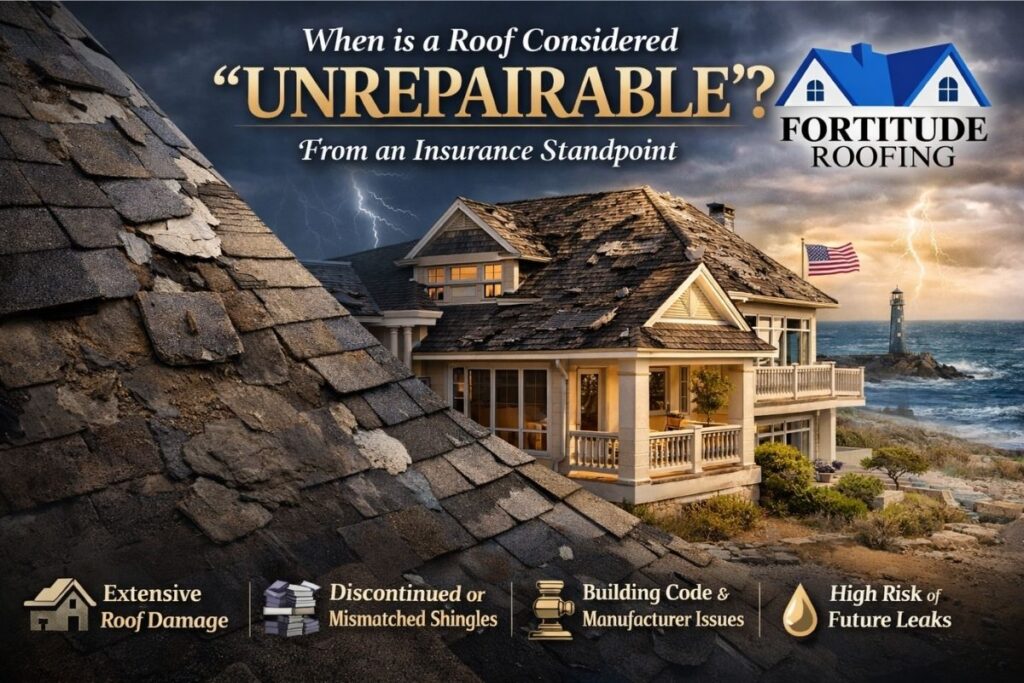
What Makes a Roof “Unrepairable” From an Insurance Standpoint
When homeowners hear “your roof is repairable,” they often assume it means, “A few shingles can be replaced and everything is fine.” In insurance terms, “repairable” is more specific: the roof can be restored to its pre-loss condition with a reasonable repair scope—without creating performance risk, code/manufacturer conflicts, or material availability issues.
This guidance is written for coastal North Carolina homeowners (Carteret, Craven, Onslow, Pender, Brunswick, and New Hanover counties), where repeated wind and storm cycles make “paper repairs” fail in the field.
Quick Definition: What Does “Unrepairable” Mean in Roof Insurance Language?
Carriers may not always use the word “unrepairable” formally. In practice, the question is whether the roof can be reasonably repaired to pre-loss condition.
A roof is effectively “unrepairable” for an insurance claim when repairs cannot reasonably:
- restore the roof to pre-loss condition, or
- provide reliable long-term performance, or
- comply with current codes and manufacturer requirements, or
- be completed due to material availability or matching constraints.
Insurance decisions are based on restoration feasibility, not just the cheapest short-term fix.
Roof Repair vs Replacement (Insurance): How Insurers Decide
Insurers and adjusters typically evaluate repairability using a combination of technical and practical factors. The exact language varies by policy, but the decision logic is usually consistent.
1) Extent and Distribution of Damage
Insurers look at:
- how much damage exists,
- where it is located, and
- whether damage is concentrated (one area) or scattered (multiple slopes/facets).
Key point: Scattered wind or storm damage across multiple facets can be harder to repair reliably than a single damaged zone—even if the total “count” looks small.
2) Ability to Restore Pre-Loss Condition
A repair is only “acceptable” if it restores:
- water-shedding performance,
- wind resistance,
- sealing integrity,
- and (depending on policy language and endorsements) appearance/value.
If replacing a small section creates weak transitions or compromises the roof system, insurers may still argue “repairable” unless documentation clearly shows why the repair fails the pre-loss restoration standard.
3) Material Availability and Matching (Including Discontinued Shingles)
Many repairability disputes come down to a simple issue: you can’t repair what you can’t match.
Insurers will consider:
- whether the shingle/material is still manufactured,
- whether color/profile differences create a patchwork effect,
- whether mismatching impacts value (policy-dependent), and
- whether a partial replacement violates manufacturer requirements for a uniform system.
This is common with older architectural shingles, specialty profiles, and coastal-exposed products that weather differently by slope orientation.
4) Code and Manufacturer Requirements in Coastal North Carolina
Code and manufacturer requirements can turn a “simple repair” into a larger scope—especially in coastal markets like Wilmington, Hampstead, Surf City, Jacksonville, Morehead City, Beaufort, Leland, Southport, and Oak Island.
Roof work often intersects with:
- underlayment and flashing details,
- wind-uplift installation requirements (varies by location/exposure),
- decking attachment/replacement when deterioration is discovered,
- ventilation requirements tied to manufacturer installation specs.
If compliance requires work extending beyond the damaged area, repairability becomes less clear.
5) Long-Term Performance Risk
A technically possible repair can still be functionally poor.
Adjusters and engineers often ask:
- Will repairs create hinge points or seal failures at transitions?
- Will repaired areas age differently and become future failure zones?
- Will the fix shorten roof life and increase the likelihood of leaks or blow-offs?
A roof can be treated as “unrepairable” when repairs create an unacceptable probability of future failure.
Common Scenarios Where Replacement Is More Likely
Replacement is more likely to be justified when repairability breaks down in predictable ways, such as:
- Damage across multiple slopes/facets (distributed wind damage)
- Older/brittle shingles that cannot be lifted without collateral breakage
- Discontinued shingles or non-matchable profiles/colors
- Manufacturer requirements that cannot be met with partial replacement
- Code/compliance constraints that expand scope beyond the damaged area
- Repairs that introduce high-risk transitions likely to fail under future wind events
This is not a guarantee of coverage. It is a practical summary of when “repair to pre-loss condition” is harder to defend.
Why Spot Repairs Often Fail After Wind Events
Spot repairs are appealing because they appear cheaper. In real-world coastal conditions, they often fail for predictable reasons:
- Collateral damage risk: lifting tabs to replace a few shingles frequently breaks seals and disturbs surrounding shingles.
- Seal re-activation issues: older shingles may not reseal consistently after disturbance.
- Multiple leak entry points: several small repair zones can become multiple weak points.
- Non-uniform aging: patched areas weather differently and can become early failure zones.
Bottom line: A roof can be “repairable on paper” but not reliably restorable as a system.
Documentation That Helps Support “Not Reasonably Repairable”
If you want an insurer to consider replacement, frame the issue as restoration feasibility, not preference.
Evidence that commonly strengthens the case:
- Slope-by-slope photo documentation showing damage distribution
- Close-ups of creases, seal failures, lifted tabs, missing shingles, punctures
- Notes showing why repairs would require disturbing intact shingles and creating failure zones
- Supplier/manufacturer confirmation of discontinued materials or inability to match
- Documentation of code/manufacturer constraints encountered during evaluation
- Risk-based rationale: why repairs increase probability of future leaks/blow-offs
Avoid arguing from emotion (“it’s too old,” “it looks bad,” “I don’t trust repairs”). Argue from system performance and pre-loss restoration requirements.
What to Do Next (Before You File or Escalate a Claim)
If you suspect your roof is not reasonably repairable, use a simple process:
- Document the roof by slope: wide shots + close-ups of each slope/facet.
- Limit work to emergency mitigation: tarp or temporary measures only until documentation is complete.
- Get a professional inspection report: include a slope map and damage distribution narrative.
- Ask the carrier the right question: “What standard are you using to determine pre-loss restoration feasibility?”
- Confirm shingle availability/matching: request a supplier letter if discontinued or non-matchable.
- Identify code/manufacturer constraints: note where a partial repair would conflict with requirements.
- Submit an evidence package: organized photos, slope map, availability letter, and a clear restoration-feasibility explanation.
If you need a local evaluation, consider linking to your city pages here:
- [Roof inspection in Wilmington]
- [Storm damage roof inspection in Jacksonville]
- [Roof repair vs replacement guidance in Emerald Isle]
(Use your existing service page URLs for these anchors.)
FAQs
What does “unrepairable roof” mean for an insurance claim?
It generally means the roof cannot be reasonably repaired to restore pre-loss condition and long-term performance. The limiting factor is often damage distribution, matching/discontinued materials, code/manufacturer requirements, or elevated failure risk.
Can a roof be “unrepairable” even with limited visible damage?
Yes. Damage may be limited in quantity but scattered across multiple slopes, or repairs may be impossible to match or perform without compromising system integrity.
Does shingle matching matter to insurance?
Often, yes. If materials are discontinued or cannot be reasonably matched, partial replacement can fail to restore pre-loss condition or may trigger policy/endorsement considerations. The impact depends on your policy language.
Why would an insurer deny replacement but approve repairs?
Because carriers generally default to the least-cost option if they believe the roof can be restored to pre-loss condition through repair. The dispute is usually about restoration feasibility, not cost.
Will insurance pay for a full roof replacement in North Carolina?
Sometimes. It depends on your policy and whether repair can reasonably restore pre-loss condition without performance risk or compliance conflicts. The stronger the documentation of repair limitations, the clearer the argument becomes.
What evidence best supports “not reasonably repairable”?
A slope-by-slope photo set, a roof inspection report with a slope map, documentation of collateral damage risk, a supplier/manufacturer letter on discontinued or non-matchable shingles, and notes showing code/manufacturer requirements that expand scope.
Final Takeaway
A roof can be “unrepairable” even when damage looks limited. Insurance decisions generally turn on whether the roof can be reasonably restored to pre-loss condition—not simply whether a cheaper repair exists. If repairs cannot restore pre-loss condition due to scattered damage, matching constraints, code/manufacturer requirements, or performance risk, replacement may be justified.
If you’re unsure whether your roof is truly repairable after a storm, a professional evaluation can clarify the scope before you file—especially in coastal North Carolina where repeated wind events make marginal repairs fail.
Fortitude Roofing Service Area (Coastal NC)
Fortitude Roofing serves homeowners across coastal North Carolina, including:
- Carteret County: Atlantic Beach, Beaufort, Cape Carteret, Cedar Point, Emerald Isle, Indian Beach, Morehead City, Newport, Pine Knoll Shores
- Craven County: New Bern, Trentwoods
- Onslow County: Jacksonville, Holly Ridge, North Topsail Beach, Richlands, Surf City, Swansboro
- Pender County: Hampstead, Topsail Beach, Burgaw
- Brunswick County: Leland, Southport, Oak Island, Holden Beach, Ocean Isle Beach, Shallotte, Sunset Beach, Carolina Shores, Calabash, Bolivia, St. James
- New Hanover County: Wilmington, Wrightsville Beach, Carolina Beach, Kure Beach
Author and Review
Reviewed by: Fortitude Roofing (Coastal NC)
This article is for educational purposes. Coverage decisions depend on policy language, endorsements, and carrier determinations.