Standing Seam Metal Roofing Explained
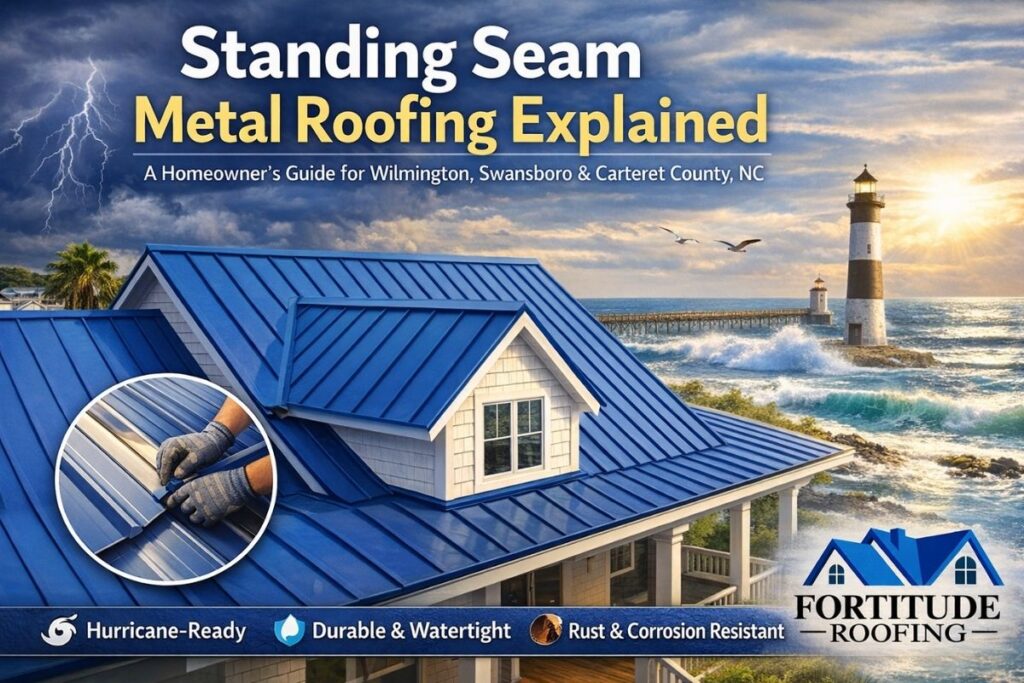
Standing Seam Metal Roofing Explained
A Homeowner’s Guide for Wilmington, Swansboro & Carteret County, NC
Standing seam metal roofing is one of the highest-performing roof systems available for coastal and near-coastal North Carolina. When properly designed and installed, it delivers long service life, strong wind performance, and low maintenance—making it a practical option for homeowners who value durability and risk reduction over the lowest upfront price.
Fortitude Roofing serves Eastern NC, including Wilmington (New Hanover County), Swansboro (Onslow County), and communities across Carteret County.
Quick Answer: What Is Standing Seam Metal Roofing?
Standing seam metal roofing is a premium roof system made from vertical metal panels that interlock with raised seams. Fasteners are concealed (hidden), improving long-term watertightness and durability—especially in high-wind, high-rain coastal environments like Wilmington, Swansboro, and Carteret County.
Why Standing Seam Gets So Much Attention in Coastal North Carolina
Roofs in southeastern NC must withstand:
- Hurricane and tropical-storm wind loads
- Wind-driven rain (a primary driver of leaks)
- Salt air and corrosion pressure near the coast
- Intense sun/UV and heat cycling
- High humidity and frequent rain events
Standing seam is popular here because it’s engineered to manage movement, water, and wind better than many exposed-fastener metal roofs—and many shingle assemblies—when the detailing is executed correctly.
The Basics: How Standing Seam Metal Roofing Works
Standing seam systems are defined by three core characteristics:
1) Vertical metal panels
Panels typically run from ridge to eave, shedding water efficiently and reducing horizontal seams (common leak points in many roof assemblies).
2) Raised, interlocking seams
Seams are raised above the water plane and locked together (method varies by system). This:
- improves water management,
- increases wind resistance,
- keeps critical joints out of standing water paths.
3) Concealed fasteners
Unlike exposed-fastener metal roofs (where screws are visible and weather-exposed), standing seam hides fasteners beneath the panels or within the seam/clip system. This helps:
- reduce fastener back-out over time,
- accommodate expansion/contraction,
- preserve long-term watertight performance.
Standing Seam Types Homeowners Should Understand
Not all “standing seam” is the same. The seam and attachment method drive performance and price.
Snap-lock vs. mechanically seamed
- Snap-lock: faster install; commonly used on steeper slopes; strong performance when properly specified
- Mechanically seamed: seams are locked with a seaming process; often preferred for lower slopes or higher exposure applications
Clip-fastened vs. nail-flange systems
- Clip-fastened: panels attach with clips, allowing controlled movement and excellent long-term performance
- Nail-flange: panels fasten through a flange; can be appropriate in some designs, but coastal detailing and fastener strategy matter
Bottom line: When comparing bids in Wilmington, Swansboro, or Carteret County, confirm you’re comparing the same system class—not just “metal roof.”
Why Standing Seam Performs Well in Wilmington, Swansboro & Carteret County
Wind performance (system-dependent)
Standing seam systems are widely selected for high-wind regions because they can be engineered with:
- stronger seam designs,
- tighter clip spacing,
- perimeter-zone reinforcement (edges and corners are where uplift forces concentrate).
Wind rating depends on the exact system, panel profile, fastening/clip strategy, roof geometry, and installation quality. Avoid any contractor claiming performance without specifying system and attachment details.
Salt-air durability (coastal detailing matters)
Near the coast, metal selection and corrosion strategy are decisive. A properly specified coastal system typically considers:
- panel material (often aluminum or corrosion-resistant coated steel),
- high-performance coastal-grade coatings,
- stainless or appropriately corrosion-resistant fasteners and accessories,
- disciplined flashing strategy at transitions and penetrations.
Water management in wind-driven rain (details decide outcomes)
Coastal storms create wind-driven water pathways that expose weak details. Standing seam performs extremely well when:
- underlayment strategy is correct,
- flashing is designed and executed precisely,
- penetrations and terminations are handled with purpose (not generic sealant “fixes”).
How Long Does a Standing Seam Metal Roof Last in Eastern NC?
Standing seam is often selected specifically because it can deliver multi-decade service life when:
- the correct panel material/coating is used for the exposure,
- the underlayment assembly is appropriate,
- the system is installed to manufacturer requirements,
- coastal detailing (fasteners, flashings, penetrations) is done correctly.
Instead of fixating on a single number, evaluate the drivers of lifespan: material/coating, detailing quality, exposure level, roof geometry, and maintenance.
Is Standing Seam Metal Roofing Noisy?
Usually no—not on a typical home.
Standing seam is typically installed over solid decking with quality underlayment. In that assembly, it is generally comparable to other roof systems during rain. Noise complaints most often come from:
- open framing (barns, sheds, unconditioned structures),
- inadequate underlayment strategy,
- improper installation methods.
Standing Seam Metal vs. Asphalt Shingles in Coastal NC
A practical comparison for coastal and near-coastal homeowners:
| Consideration | Standing Seam Metal | Asphalt Shingles |
| Longevity Potential | High (system-dependent) | Moderate (climate dependent) |
| Wind Resilience | High (system-dependent) | Moderate to high (product/installation dependent |
| Maintenance profile | Low when detailed correctly | Moderate |
| Upfront Costs | Higher | Lower |
| Coastal Corrosion Exposure | Manageable with correct specs | Not Applicable, but shingles face seal/aging pressure |
| Best fit | Long term ownership, high exposure, high value homes | Budget-driven, shorter ownership horizon, many standard applications |
Common Misconceptions (Quick Corrections)
“Metal roofs rust near the coast.”
Not necessarily. Corrosion risk is managed through correct material/coating selection and coastal detailing.
“Metal roofs attract lightning.”
Metal does not increase the likelihood of a lightning strike. The bigger issue is proper grounding and overall electrical safety—independent of roofing choice.
“Standing seam only works on modern homes.”
Standing seam comes in colors and profiles that suit coastal, traditional, and transitional architecture throughout Wilmington, Swansboro, and Carteret County.
Installation Quality Matters More Than the Material
Standing seam is not a commodity product. Most real failures trace back to installation and detailing—not the idea of metal itself.
High-impact execution areas include:
- underlayment and moisture barrier strategy,
- correct seam/clip method for slope and exposure,
- precision flashing at chimneys, walls, vents, and valleys,
- terminations at eaves/rakes/ridges,
- penetrations (pipe boots, exhaust vents, skylights),
- proper allowance for thermal movement.
Questions to ask any standing seam contractor
- What seam type is being installed (snap-lock or mechanically seamed)?
- Is it clip-fastened? What clip spacing and perimeter strategy are used?
- What underlayment/water barrier strategy is included (especially for wind-driven rain)?
- How are penetrations and transitions detailed (and with what components)?
- What corrosion strategy is used for coastal exposure (fasteners, accessories, coatings)?
- Who supervises installation on-site, and what closeout documentation is provided?
If answers are vague, you’re buying uncertainty.
Is Standing Seam Right for Your Home?
Standing seam is often a strong fit if you:
- live in higher wind or coastal exposure zones,
- want minimal maintenance and long-term performance,
- plan to stay in the home long-term,
- value resilience over the lowest upfront cost,
- have roof geometry and slope that support the right standing seam system.
A professional evaluation should consider roof slope, geometry, exposure, ventilation, and detailing complexity—not just “metal vs shingles.”
Service Areas: Wilmington, Swansboro & Carteret County
Fortitude Roofing serves coastal and near-coastal Eastern NC, including:
- Wilmington and surrounding New Hanover County communities
- Swansboro and surrounding Onslow County communities
- Carteret County communities (including coastal and inland exposure zones)
Also serving nearby coastal communities including Emerald Isle, Morehead City, Beaufort, Atlantic Beach, Jacksonville, Hampstead, Surf City, Topsail Beach, and surrounding areas.
Schedule a Standing Seam Roof Evaluation
Homeowners considering standing seam benefit from understanding:
- which standing seam system class fits their roof and exposure,
- material/coating options appropriate for coastal conditions,
- expected performance tradeoffs,
- cost vs long-term value.
Fortitude Roofing offers professional evaluations so you can make a clean decision based on engineering realities and ownership goals, not generic marketing claims.
FAQs
What is standing seam metal roofing?
A concealed-fastener metal roof system made of vertical panels with raised interlocking seams designed for durability, thermal movement, and strong water management.
Is standing seam metal roofing good for coastal North Carolina?
Often, yes—when the correct material/coating and coastal detailing are used. The system is commonly chosen for wind resilience and long service life in high-exposure environments.
Does standing seam metal roofing leak?
Any roof can leak if details are wrong. Standing seam systems perform extremely well when seams, flashing, penetrations, terminations, and underlayment are executed correctly.
Is standing seam louder than shingles?
Usually no, when installed over solid decking with appropriate underlayment on a typical conditioned home.
Author and Review
Reviewed by: Fortitude Roofing (Coastal NC)
Educational content only. Product performance depends on system selection, roof geometry, exposure conditions, and installation method.