How to File an Insurance Claim for Roof Damage in Brunswick County, NC
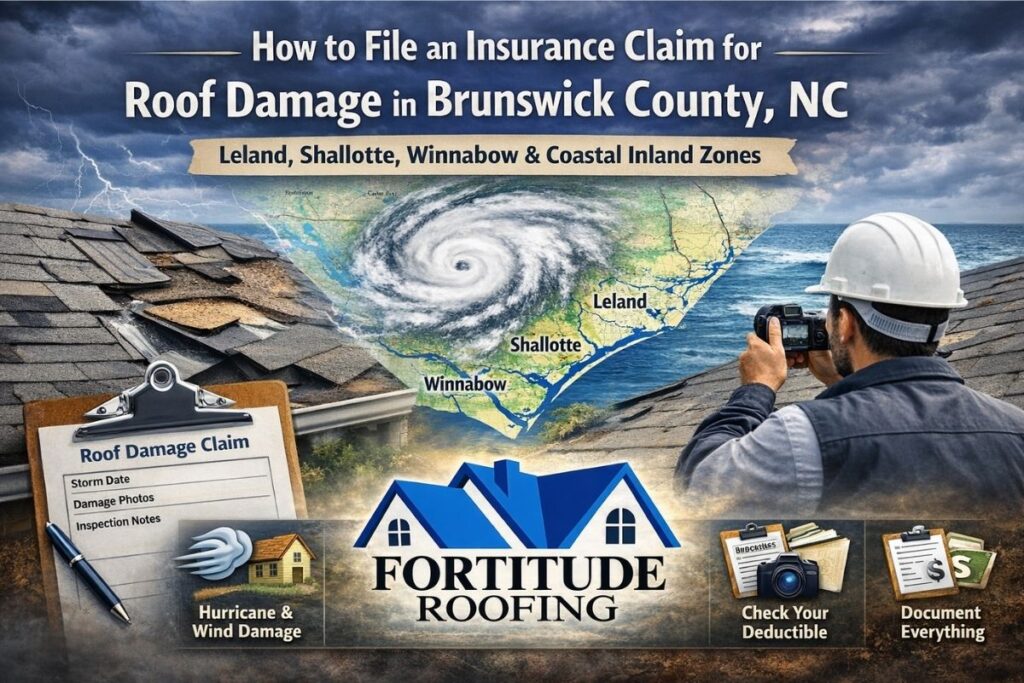
How to File an Insurance Claim for Roof Damage in Brunswick County, NC
Leland, Shallotte, Winnabow, and Coastal Inland Zones
Roof insurance claims in Brunswick County differ slightly from barrier-island markets, but wind exposure and storm-related damage are still major drivers—especially in Leland, Shallotte, Winnabow, and nearby communities. Homes farther inland can still experience hurricane-force gusts and wind-driven rain, and the most important roof damage often isn’t visible from the ground.
This guide explains how roof claims typically work in Brunswick County, what damage patterns to look for, how policy structure can change out-of-pocket costs, and how to protect your claim with disciplined documentation.
Fortitude Roofing serves Brunswick County, including Leland, Shallotte, Winnabow, and surrounding communities.
Quick Answer: Roof Insurance Claims in Brunswick County
In Brunswick County, roof damage claims are commonly filed after hurricanes, tropical storms, and severe wind-driven events. Damage is often subtle—lifted tabs, broken seals, creases, flashing separation—without obvious missing shingles. Prompt inspection and clear documentation improve outcomes by establishing a storm date narrative and proving damage patterns consistent with a sudden event rather than gradual wear.
Why Brunswick County Claims Require a “Coastal-Adjacent” Mindset
Brunswick is not uniform. Some areas are more directly coastal; others are inland but still exposed to high gusts as storms track through the Cape Fear region. That means:
- you may see meaningful wind damage without dramatic roof surface loss,
- roofs can show a mix of storm-driven change and baseline aging,
- multiple storms in a season can complicate the date-of-loss decision.
A strong claim strategy separates what changed due to a specific event from what existed before.
Typical Roof Damage Patterns in Brunswick County
After wind-driven storms, professionals commonly find:
- Shingle creasing and uplift (often concentrated at ridges, edges, corners, and exposed slopes)
- Nail pull-through / fastener-related issues from wind pressure and uplift cycling
- Flashing separation at roof-to-wall transitions and penetrations
- Granule loss that appears accelerated after severe storms (needs careful interpretation vs aging)
- Wind-driven rain intrusion at vulnerable details even without missing shingles
Important: “No missing shingles” does not mean “no storm damage.” Uplift damage often shows up as seal failure, creasing, and pattern-based distribution.
Insurance Considerations in Brunswick County (Before You File)
Policies vary, but these are common realities homeowners should understand:
1) Wind Deductibles Can Apply Inland
Even in inland zones, wind deductibles or storm-specific deductibles may apply depending on your carrier and policy structure.
2) Named Storm vs Standard Wind Event Language
Some policies distinguish between named storms and other wind events. This can affect deductible type and claim economics. Verify how your policy defines and applies these terms.
3) Roof Age and Depreciation Schedules Matter
Many policies apply depreciation differently as a roof ages, and some coverage structures change materially based on roof age. Do not assume the claim economics without checking your policy’s settlement method.
Practical implication: Before filing, confirm which deductible applies and how settlement works for your roof age and coverage type.
Step-by-Step: Recommended Claim Process in Brunswick County
Step 1: Protect the Property (Emergency Mitigation)
If you have active leaks:
- contain water and document interior staining,
- use temporary measures (tarping) if needed,
- avoid permanent repairs until documentation is complete unless required to prevent further damage.
Step 2: Inspect After Any Major Storm (Even If You Don’t See Damage)
Because Brunswick wind damage is often subtle, start with a professional inspection when:
- you experienced strong gusts,
- debris impacts occurred,
- neighbors had roof issues,
- you see lifted tabs, creases, or interior staining.
Step 3: Document the Roof by Slope (Not Just “The Bad Spot”)
Capture:
- wide photos of each slope (front/back/left/right or N/S/E/W),
- close-ups of lifting, creasing, broken seals, displaced tabs, missing pieces,
- ridge/edge zones (eaves, rakes, hips, ridge caps),
- flashing and transitions (roof-to-wall, chimneys, pipe boots),
- collateral evidence (gutters, vents, screens, soft metals, siding impacts),
- interior evidence (stains, wet insulation) with dates.
If you want the claim to be defensible, the documentation should show the roof as a system.
Step 4: Confirm the Storm Date Narrative
When storms stack up, claims get messy. Identify the event window you’re anchoring to and document:
- the storm date,
- what changed afterward (leak onset, lifted shingles noticed, debris impact evidence).
Step 5: Review Deductible and Settlement Terms
Before filing, confirm:
- whether a wind or named-storm deductible applies,
- the amount you would be responsible for,
- how settlement works for your roof age (policy-specific).
Step 6: File the Claim Directly With the Carrier (If Damage Is Suspected)
When filing:
- provide the storm date,
- describe the observed change (missing shingles, leak onset, uplift indicators),
- avoid speculation beyond what’s documented.
Step 7: Coordinate the Adjuster Inspection
Be present or have your contractor present to:
- ensure all slopes are reviewed (not only the easiest to access),
- provide slope-by-slope photos and notes,
- point out ridge/edge concentration and pattern evidence.
Step 8: Expect Supplements (Normal, Not Adversarial)
If the carrier scope does not include work required to build the roof correctly, supplements are typically handled through:
- photos tied to line items,
- documentation of concealed conditions discovered during tear-off,
- manufacturer requirements where applicable,
- clear explanation of why the initial scope can’t restore pre-loss performance.
Evidence-driven supplements are standard in storm markets.
Common Mistakes That Create Avoidable Denials or Friction
Avoid these Brunswick County patterns:
- waiting for leaks to appear before inspecting,
- delaying documentation for weeks/months after the event,
- mixing multiple storm dates without a clean narrative,
- filing without slope-by-slope evidence,
- approving permanent repairs before documentation (except true emergency mitigation),
- focusing on roof age rather than storm causation and damage patterns.
FAQs
Can inland Brunswick County homes still have hurricane-level roof damage?
Yes. Inland zones can still experience hurricane-force gusts and wind-driven rain, especially when storms track through the region. Damage may be subtle and pattern-based.
Should I file a claim if there are no missing shingles?
Possibly. Wind uplift damage can break seals and crease shingles without tearing them off. A professional inspection and documentation are typically the right first step.
Do wind deductibles apply in Brunswick County even away from the beach?
They can. Deductible structure is policy-specific. Verify whether your policy applies wind or named-storm deductibles based on event type and location.
Why does the adjuster scope often differ from the contractor estimate?
The adjuster scope reflects what the carrier initially approves as covered. The contractor estimate reflects what is required to build the roof correctly in real conditions. Differences are commonly resolved through documentation-supported supplements.
Final Takeaway
Roof insurance claims in Brunswick County are process-driven and time-sensitive. Homeowners are best protected when they act early, document thoroughly, understand deductible and settlement terms, and use contractors with regional storm experience. In coastal-adjacent markets like Brunswick, damage distribution and pattern evidence often matter more than whether shingles are visibly missing.
Serving Brunswick County Homeowners
Fortitude Roofing works with homeowners throughout Leland, Shallotte, Winnabow, and surrounding Brunswick County communities, providing construction-focused inspections and long-term roofing solutions built for North Carolina weather.
Fortitude Roofing’s role is to inspect, document, and build roofing systems that perform—not to negotiate insurance claims.
Author and Review
Reviewed by: Fortitude Roofing (Brunswick County / Coastal NC)
Educational content only. Coverage depends on policy language, endorsements, deductibles, and carrier determinations.