Why Metal Roof Performance Depends on Installation Details
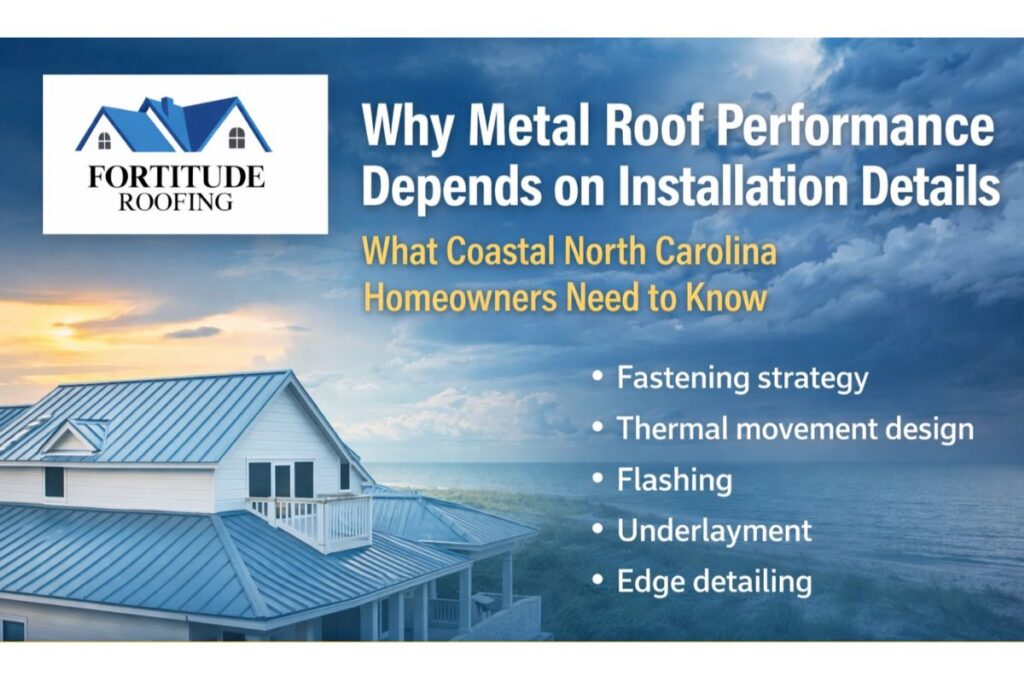
Why Metal Roof Performance Depends on Installation Details
Standing seam metal roofing is often marketed as a “lifetime roof.” In reality, its long-term performance depends less on the metal panels themselves and more on how the entire system is designed and installed.
For homeowners in coastal and near-coastal Eastern North Carolina—including Wilmington, Morehead City, New Bern, Jacksonville, and surrounding communities—installation details are the difference between a roof that performs for decades and one that fails prematurely.
Quick Summary
Standing seam metal roof performance is determined primarily by installation details, not the panels alone. Fastening strategy, thermal movement design, flashing, underlayment, and edge detailing are critical—especially in coastal environments with wind-driven rain and repeated storm exposure.
Panels Don’t Fail—Systems Do
Metal roofing panels are inherently durable. Most metal roof problems in coastal NC do not come from material defects. They come from execution failures:
- Incorrect fastening methods
- No allowance for thermal expansion and contraction
- Poorly detailed penetrations and transitions
- Inadequate underlayment selection
- Weak edge and perimeter detailing
When shortcuts are taken, even premium metal panels will underperform.
Critical Installation Details That Determine Performance
Fastening Strategy
Standing seam systems rely on concealed clips and fastening patterns engineered for wind uplift. Improper clip spacing, wrong fastener types, or inconsistent attachment compromises wind resistance—especially in hurricane-prone zones.
Thermal Movement Allowances
Metal expands and contracts significantly with temperature changes. Systems must be designed to move without stress. When panels are locked down incorrectly, fasteners back out, seams deform, and leaks develop over time.
Flashing at Penetrations and Transitions
Skylights, chimneys, vents, walls, and roof-to-wall transitions are the most common failure points. In coastal environments, flashing must handle wind-driven rain, not just gravity water flow.
Underlayment Selection
Underlayment is the secondary water barrier. In coastal NC, it must resist:
- High heat
- Salt air
- Extended moisture exposure during storms
Cheap or mismatched underlayments are a frequent root cause of metal roof leaks.
Edge and Perimeter Detailing
Roof edges experience the highest wind pressures. If edge metal, cleats, and transitions aren’t engineered and installed correctly, the system is vulnerable—regardless of panel quality.
Why Coastal Environments Expose Installation Mistakes Faster
Inland installations may hide poor detailing for years. Coastal conditions do not.
Repeated exposure to:
- Strong wind uplift
- Wind-driven rain
- Salt air corrosion
- Storm cycling
means minor detailing errors become major failures much sooner. That’s why metal roofs installed without coastal-specific expertise often develop issues well before their expected lifespan.
Common Metal Roof Problems Caused by Poor Installation
- Leaks at penetrations and seams
- Oil canning worsened by improper fastening
- Fastener fatigue and clip failure
- Premature corrosion at cut edges
- Wind damage during storms
In most cases, the panels are still structurally sound—the system was simply not executed correctly.
Metal Roofing Near You: What Homeowners Should Ask
If you’re considering a standing seam metal roof in coastal North Carolina, ask:
- Is the system engineered for my wind exposure zone?
- How is thermal movement being managed?
- What underlayment system is specified—and why?
- How are penetrations and edges detailed?
- Who is responsible for system-level performance, not just installation?
The answers matter more than the brand of metal.
Local Expertise Matters With Metal Roofing
Standing seam metal roofing is not a commodity product. In coastal NC, it requires disciplined system design, experienced crews, and zero tolerance for shortcuts.
At Fortitude Roofing, metal roofing is approached as a performance system, not a panel install. Every detail is evaluated against local exposure, code requirements, and long-term durability—not just initial appearance.
A professional roof evaluation can help clarify whether a metal roofing system is being designed and detailed correctly for coastal conditions.