Barrier Island vs Inland Coastal Roof Damage Patterns
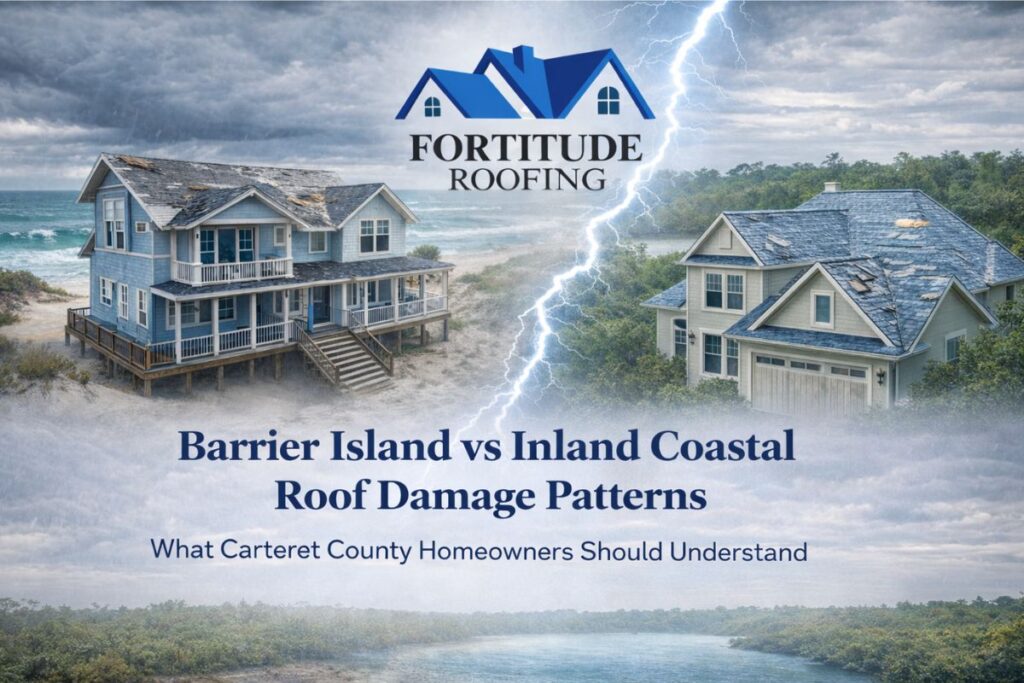
Barrier Island vs Inland Coastal Roof Damage Patterns
What Carteret County Homeowners Should Understand
Roof damage patterns in Carteret County often differ meaningfully between barrier island homes and inland coastal properties. While both are exposed to coastal storms, the type, intensity, and distribution of damage varies based on proximity to open water, wind exposure, and salt influence.
Understanding where a home sits along the coast helps explain how damage occurs and why professional inspection and documentation must account for exposure—not just visible surface loss.
Quick Summary
In Carteret County, barrier island homes typically experience stronger sustained winds, higher gust exposure, and greater salt-air impact, with damage concentrated at ridges, corners, fasteners, and metal components. Inland coastal homes see slightly lower wind speeds but still suffer uplift damage, broken seals, and wind-driven rain intrusion during close-tracking hurricanes.
Why Barrier Island Homes Experience Different Damage
Barrier island properties face the most severe coastal exposure.
Higher Wind and Gust Pressure
With little obstruction from trees or structures, barrier islands experience:
- Stronger sustained winds
- Higher peak gusts
- More intense uplift forces
These forces concentrate damage at edges, ridges, corners, and attachment points.
Direct Salt-Air Exposure
Salt air accelerates corrosion of:
- Metal roofing components
- Fasteners and flashing
- Exposed fastener systems
Over time, this weakens critical connections even if the roof surface appears intact.
Common Damage Patterns on Barrier Islands
Typical issues include:
- Ridge and hip cap displacement
- Fastener loosening or corrosion
- Metal edge and flashing degradation
- Panel movement or seam stress on metal roofs
Damage often begins at high-stress connection points, not in the roof field.
Inland Coastal Homes: Different Stress, Different Failures
Inland coastal properties—such as those slightly removed from open water—still face storm exposure, but with different dynamics.
Slightly Reduced Wind, Still Significant Impact
While sustained winds may be lower, inland homes still experience:
- Uplift forces during hurricanes
- Wind pressure changes from nearby terrain
- Storm-driven rain intrusion
Wind-Driven Rain as a Primary Factor
Damage frequently involves:
- Broken shingle seals
- Water intrusion at flashing and transitions
- Moisture penetration without visible shingle loss
These issues may not be obvious from the ground.
Why Exposure-Based Inspection Matters
Two homes with similar roofs can suffer very different damage depending on:
- Distance from open water
- Elevation and orientation
- Wind direction during a storm
Inspections that ignore exposure context risk missing critical damage or misinterpreting patterns.
Documentation Standards Differ by Exposure
Especially in coastal insurance claims:
- Barrier island damage often requires fastener and metal detail documentation
- Inland damage often requires slope-by-slope evaluation for uplift and moisture intrusion
Cause-based evaluation—not appearance—drives accurate assessment.
Roofing Inspections Near You in Carteret County
Homeowners in Atlantic Beach, Emerald Isle, Indian Beach, Pine Knoll Shores, Beaufort, Morehead City, and surrounding inland coastal areas experience different risk profiles—even within the same county.
Professional inspections account for:
- Local exposure conditions
- Storm-specific wind patterns
- System-level performance
Frequently Asked Questions
Do barrier island roofs fail differently than inland coastal roofs?
Yes. Barrier island roofs experience higher wind and salt exposure, leading to more edge, fastener, and metal-related damage.
Is roof damage always worse on barrier islands?
Not always, but the type and location of damage often differ due to exposure intensity.
Can inland coastal homes still have serious roof damage?
Yes. Wind uplift and wind-driven rain can cause hidden damage even without visible shingle loss.
Why does salt air matter for roof damage?
Salt accelerates corrosion of metal components, weakening attachment points over time.
Should inspections be different based on location?
Yes. Exposure-driven inspections improve accuracy and documentation quality.
A professional roof inspection can help determine how coastal exposure affects damage patterns on your home.