How Much Does a New Roof Cost in 2026 in Eastern North Carolina?
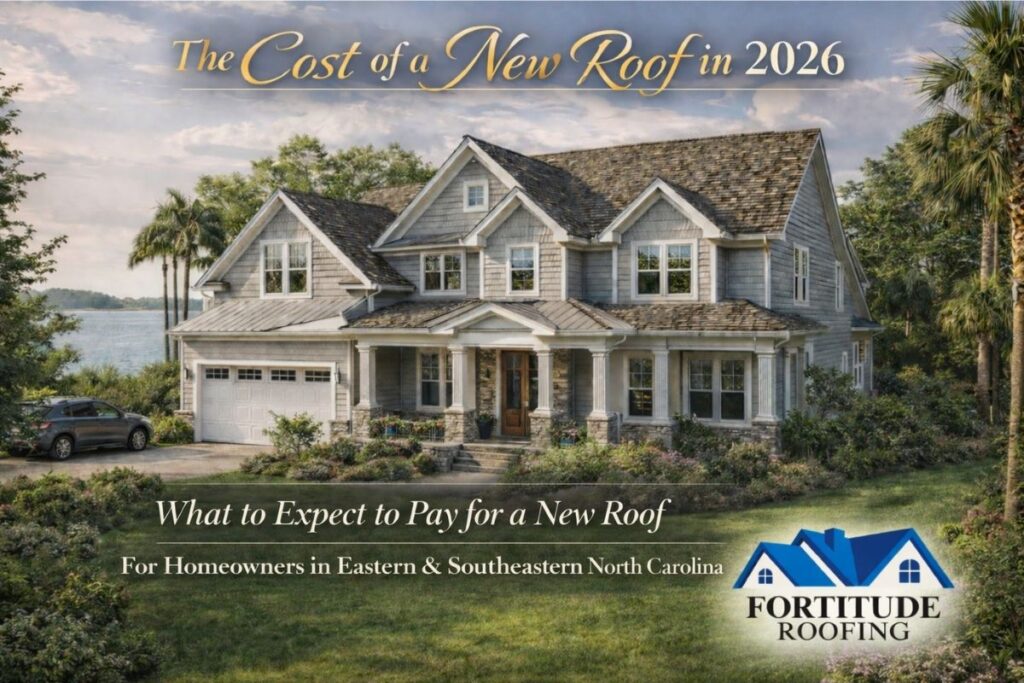
How Much Does a New Roof Cost in 2026 in Eastern North Carolina?
Planning guidance for Wilmington, Hampstead, Leland, New Bern, Morehead City, Emerald Isle, Swansboro, and surrounding coastal communities.
If you live in Eastern North Carolina—from Wilmington to New Bern, Hampstead to Emerald Isle, Leland to Morehead City—a roof replacement is one of the most consequential investments you’ll make in your home.
In 2026, homeowners need realistic expectations, not vague “per square” quotes with missing scope. The spread between a basic replacement and a coastal-ready, high-performance roof system is wider than most people expect—because the difference is usually scope and system execution, not just shingles.
Fortitude Roofing serves coastal and near-coastal Eastern NC, including New Hanover, Pender, Brunswick, Onslow, Carteret, and Craven counties.
Quick Answer: How Much Does a New Roof Cost in Eastern NC in 2026?
Most Eastern NC homeowners should budget in broad bands based on roof type and system scope:
- Shingle roof replacements: commonly mid-teens to mid-$30Ks+ for typical single-family homes, depending on roof size, complexity, and system scope. (NC averages and national shingle cost ranges support this band as a planning range.)
- Standing seam metal: commonly $20Ks to $60Ks+, driven by panel type/material, roof geometry, and detailing.
The biggest driver of “why estimates vary” is almost always what’s included: underlayment strategy, flashing scope, ventilation plan, decking assumptions, and code/wind-driven rain detailing—not the headline shingle brand.
2026 New Roof Cost at a Glance: Planning Ranges for Eastern NC
These ranges assume a full replacement (tear-off, disposal, labor/materials) and a code-compliant installation for typical single-family homes. Your specific roof can land outside these bands depending on size, complexity, and exposure.
| Roof system (typical) | 2026 planning range (Eastern NC) | What usually pushes it higher |
| Entry-level asphalt shingles | $14,000–$24,000 | steep pitch, multiple valleys/levels, decking replacement |
| Architectural/dimensional shingles | $18,000–$31,000 | upgraded underlayment/flashing, ventilation corrections |
| Premium architectural assembly | $23,000–$36,000+ | high-wind edges, enhanced water management, complex geometry |
| Standing seam metal | $30,000–$60,000+ | material choice (steel vs aluminum), clip/seam type, detailing |
Scope warning: If multiple bids are far below these bands, don’t just compare totals—compare scope (underlayment coverage, flashing, ventilation, decking assumptions, permits, disposal). National and NC cost ranges show wide variance primarily because scope varies.
Start With Roof Size (Not House Size)
Roofing is priced by roof area, not interior square footage.
- Contractors price in “squares” where 1 square = 100 sq ft of roof area.
- Roof area is often ~10–20% larger than the home’s interior square footage depending on pitch and design.
Quick estimator for budgeting (good enough for planning)
- Estimate roof area:
Roof sq ft ≈ House sq ft × 1.15 (typical planning factor) - Convert to squares:
Squares = Roof sq ft ÷ 100 - Apply a realistic installed cost band (based on system + complexity)
Example: 2,000 sq ft home
- Estimated roof area: 2,000 × 1.15 = 2,300 sq ft (≈ 23 squares)
- Shingles at ~$6–$10/sq ft installed planning band = $13,800–$23,000 plus complexity/decking allowances (ranges vary by market and scope).
- Standing seam at ~$12–$20+/sq ft planning band = $27,600–$46,000+ (material and detailing can push higher).
What Actually Drives Roof Cost in 2026 in Eastern NC
1) Roof pitch and complexity
Steeper roofs reduce crew efficiency and increase safety requirements. Valleys, dormers, skylights, chimneys, wall transitions, and multiple elevations expand labor and flashing scope. This is where “same shingles, different price” happens.
2) Material choice (and what “metal” actually means)
- Architectural shingles: strong value-per-dollar; common and widely serviceable
- Premium architectural assemblies: cost more because the system is upgraded (not just the shingle)
- Standing seam metal: different fabrication and installation category; higher detailing demands; higher labor intensity
3) Tear-off scope and decking assumptions
A quote that assumes “no decking replacement” can look cheaper until tear-off reveals reality. Strong proposals state:
- how decking is evaluated
- what triggers replacement
- a unit price per sheet (so you can budget for a realistic allowance)
4) Installation standard and warranty compliance
A roof is a system. Proposals that blur system components are not comparable. The common scope separators:
- underlayment strategy (especially for wind-driven rain)
- flashing scope/quality at transitions and penetrations
- ventilation plan (not “as needed”)
- edge detailing (rakes/eaves/corners are failure zones in wind events)
5) Disposal, permits, and logistics
Disposal and hauling costs vary; permitting varies by municipality and scope. If it’s not written clearly, you’re buying uncertainty.
Why Coastal and Near-Coastal Eastern NC Often Costs More
In markets like Wilmington, Hampstead, Surf City, Topsail-area communities, Swansboro, and Carteret County, the roof is under more stress:
- wind-driven rain finds weak flashing and edge details first
- repeated storm cycles accelerate failures at ridges, corners, and penetrations
- salt exposure can accelerate corrosion risk for certain components
Most “coastal price increases” are not arbitrary—they reflect the labor and detailing required to build a roof that performs in coastal exposure.
How to Compare Roofing Estimates Without Getting Burned
Most price gaps are scope gaps. Use this audit checklist:
- Tear-off: included? number of layers specified? disposal included?
- Underlayment: type named? full coverage vs partial?
- Flashing: chimneys, step flashing, valleys, vents, wall transitions clearly included?
- Ventilation: defined intake/exhaust plan vs vague language?
- Decking: assumptions stated? unit price per sheet written?
- Warranty compliance: components + install method meet manufacturer requirements?
- Permits: who pulls them? included?
- Cleanup/magnet sweep: written into scope?
If a contractor can’t explain scope in plain English, you’re not buying a roof—you’re buying ambiguity.
Insurance and Underwriting in 2026: Straight Talk
No roofer should promise premium reductions or claim approvals. That said, documented, code-compliant roof systems reduce ambiguity during underwriting and post-storm conversations. Your best lever is a roof built as a system—and documented as one.
Also note: broader construction costs are expected to continue moving in 2026 due to labor constraints and macro volatility; forecasts vary by segment, but the direction is still “not cheaper.” (RSMeans)
FAQ: New Roof Costs in Eastern North Carolina (2026)
What is the average cost of a new roof in Eastern NC?
Many homeowners land in the mid-teens to mid-$30Ks+ for shingle systems and $30K–$60K+ for standing seam metal, depending on roof area, complexity, and system scope. NC statewide averages and national cost ranges support broad variability driven by material and scope. (This Old House)
Why are roofing costs higher near the coast?
Because coastal and near-coastal roofs require stronger execution around wind-driven rain, edges, penetrations, and corrosion-aware components—more labor and better detailing, not just more shingles.
Is standing seam metal worth the cost in Eastern NC?
For long-term homeowners and higher-exposure properties, standing seam often performs well on lifecycle value due to durability and lower maintenance (when specified and detailed correctly).
Can I trust a very low estimate?
Sometimes—but treat it as a scope-audit trigger. Extremely low bids often exclude underlayment upgrades, flashing scope, ventilation corrections, decking allowances, permits/disposal, or reduce installation standards.
Final Takeaway: What to Budget in 2026
Roof replacement costs in 2026 reflect real labor and performance requirements—especially in storm-exposed Eastern NC markets. The best decision is rarely the lowest number. It’s the most predictable, documented, system-correct outcome.
2026 planning ranges (Eastern NC):
- $14,000 – $36,000+ for shingle roof systems
- $30,000 – $60,000+ for standing seam metal systems
Schedule a Roof Replacement Evaluation in Eastern North Carolina
Fortitude Roofing provides no-pressure evaluations and clear proposals across:
Wilmington | New Bern | Hampstead | Emerald Isle | Morehead City | Leland | Swansboro | Cape Carteret | Newport | Shallotte | Surrounding Eastern NC
If you want a 2026 cost estimate based on your home’s actual roof area and system scope, schedule a professional inspection. Decision quality improves with measurements and a defined system plan.