How Storm Damage Patterns Are Evaluated Across an Entire Roof
How Storm Damage Patterns Are Evaluated Across an Entire Roof
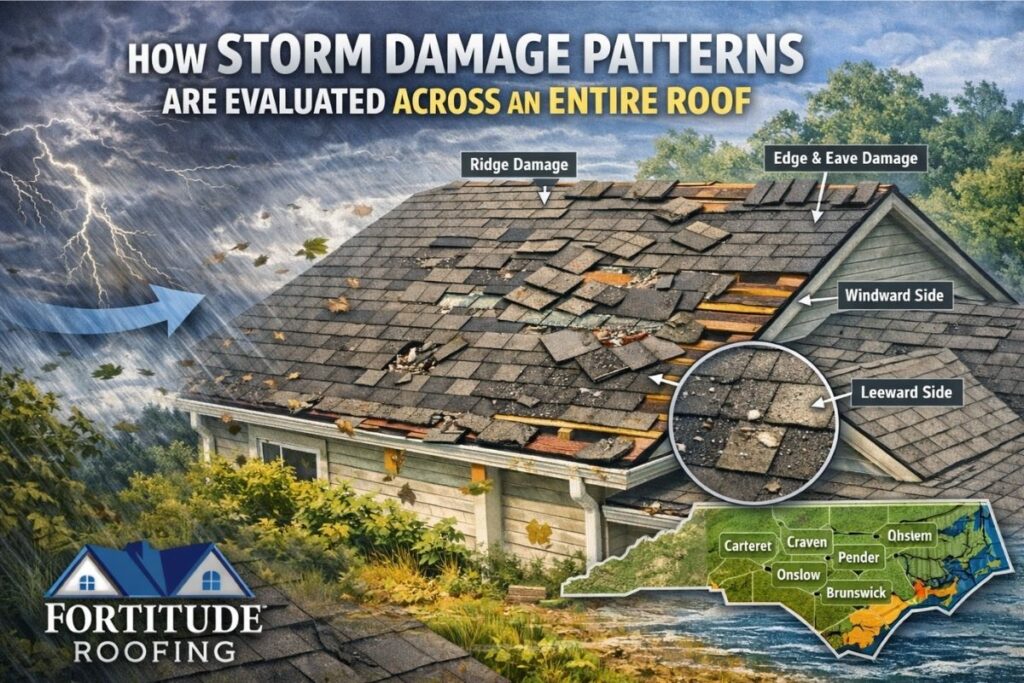
Homeowners often assume roof damage is evaluated shingle by shingle. In professional inspections—especially when insurance is involved—roofs are typically evaluated as a system. That means the most important question is often not “How many shingles are damaged?” but “Does the damage pattern match a storm event—or does it look like normal aging?”
This guide explains how storm damage patterns are evaluated across an entire roof, what indicators professionals look for, and why damage distribution frequently matters more than the severity of any single shingle.
Fortitude Roofing serves Carteret, Craven, Onslow, Pender, Brunswick, and New Hanover counties.
Quick Answer: How Do Professionals Evaluate Storm Damage Patterns?
Professionals evaluate storm damage by looking for consistent patterns across slopes that match:
- storm direction and exposure,
- windward vs leeward behavior,
- ridge/edge concentration where uplift forces are highest,
- and damage distribution that aligns with a specific event rather than uniform aging.
Patterns help distinguish storm damage from wear because storms tend to produce directional, slope-dependent impacts, while wear tends to be gradual and broadly uniform.
Why Roofs Aren’t Evaluated Shingle-by-Shingle
A roof is designed to function as a layered system: decking, underlayment, flashing, ventilation, and the roof covering (shingles/metal/etc.). A repairability or storm-damage conclusion must address whether the system can:
- shed water reliably,
- resist wind uplift,
- maintain sealing integrity,
- and be restored to pre-loss condition (when relevant).
Because storms act on the roof as a whole—especially at edges, ridges, and exposed slopes—pattern evaluation is often the most reliable way to interpret what happened.
Pattern Indicators Professionals Look For
1) Directional Impact
Wind and wind-driven debris rarely affect a roof evenly. Professionals look for damage that aligns with the storm’s direction, including:
- consistent lifting or creasing orientation,
- displaced tabs that “point” in a common direction,
- debris impact concentration on slopes facing prevailing wind.
When damage looks random without directional logic, it may be harder to attribute to a single event.
2) Slope Exposure and Geometry
Not all slopes experience the same forces. Professionals account for:
- roof pitch (steeper slopes can experience different uplift behavior),
- roof height and open exposure (coastal homes, open lots, and waterfront properties),
- complex geometry (valleys, dormers, intersecting rooflines) that creates turbulence zones.
This is why one slope may show heavy damage while another looks relatively unaffected.
3) Windward vs Leeward Damage
Windward slopes may experience direct pressure, while leeward slopes often experience suction and uplift. Pattern review considers:
- damage concentrated on the most exposed faces of the home,
- leeward uplift patterns near transitions and edges,
- consistent differences between slopes that match expected wind behavior.
A credible storm pattern often shows a logical relationship between the home’s orientation and where damage occurred.
4) Ridge and Edge Concentration
Ridges, hips, rakes, and eaves are high-stress zones because wind forces intensify at roof perimeters. Professionals commonly see storm damage clustered in:
- ridge caps and hip lines,
- leading edges (rakes) and eaves where uplift starts,
- corners and perimeter zones where turbulence is strongest.
If the damage is heavily concentrated at ridges/edges, that tends to support wind involvement more than uniform aging.
5) Scatter vs Single-Zone Distribution
Storm damage can be:
- concentrated (one face of the roof takes the hit), or
- scattered across multiple facets (gusts and turbulence affect several slopes).
The key is whether the distribution is consistent with a storm’s mechanics—not whether it’s “a lot” or “a little.” A small number of shingles across many slopes can sometimes create bigger repairability issues than a single cluster on one slope.
6) Collateral Indicators on the Property
Pattern evaluation often includes evidence beyond shingles, such as:
- damaged ridge vents or exhaust vents,
- displaced flashing or drip edge issues,
- impacts on soft metals (where applicable),
- gutters/downspouts disturbed or dented,
- screens, siding, or exterior components affected in the same directional pattern.
Collateral indicators help validate that a roof pattern is part of a broader storm footprint.
Why Patterns Matter: Distinguishing Storm Damage From Wear
The central purpose of pattern analysis is causation: did a discrete event create sudden damage, or are conditions consistent with gradual deterioration?
Storm patterns tend to be:
- directional and slope-dependent,
- concentrated at edges/ridges or exposed faces,
- clustered in turbulence zones and transitions,
- consistent with a specific event window.
Wear patterns tend to be:
- gradual and widespread,
- relatively uniform across slopes (with predictable sun/UV variation),
- associated with brittleness, granule loss, and sealant aging,
- hard to tie to a specific date.
Important point: Many coastal NC roofs show both conditions. Pattern evaluation helps separate event-driven changes from baseline aging.
What Homeowners Should Do to Support a Pattern-Based Evaluation
If you want a defensible outcome (whether for planning, repairability, or insurance), make it easier to evaluate the roof as a system:
- Document by slope (not by “problem areas” only): wide shots + close-ups for each slope/facet.
- Label photos by slope and orientation (front/back/left/right, or north/south/east/west).
- Capture edges and ridges intentionally: eaves, rakes, hips, ridge caps, and valleys.
- Document collateral indicators: gutters, vents, screens, soft metals, exterior damage patterns.
- Tie to a storm date when relevant: note when conditions changed (leak onset, missing shingles noticed, etc.).
- Avoid mixing multiple storm dates in one narrative unless a professional strategy supports it.
A professional evaluation should produce a slope-by-slope narrative explaining why the damage distribution is (or is not) consistent with a storm event.
FAQs
Why does damage distribution matter more than a single severe spot?
Because storms create roof-wide forces and predictable high-stress zones. Distribution helps prove whether damage is event-driven and whether the roof can be reliably restored as a system.
Can a roof have storm damage on only one slope?
Yes. It is common for one face of the roof to take the brunt depending on wind direction, exposure, and geometry.
What does “windward vs leeward” mean in roof inspections?
Windward refers to the side facing the wind’s direction; leeward is sheltered from direct wind but may experience uplift suction. Both can show storm-related damage, often in different patterns.
How do professionals tell storm damage from wear and tear?
They look for slope-dependent, directional patterns and perimeter concentration that align with a specific event, versus gradual and relatively uniform deterioration consistent with aging.
Final Takeaway
Professionals do not evaluate roofs purely shingle by shingle. They evaluate patterns across the entire roof system. Patterns help distinguish storm damage from wear, and damage distribution often matters more than the severity of any single shingle—especially when repairability and pre-loss restoration are the real questions.
Fortitude Roofing Service Area (Coastal NC)
Fortitude Roofing serves homeowners across coastal North Carolina, including Carteret, Craven, Onslow, Pender, Brunswick, and New Hanover counties—such as Wilmington, Hampstead, Surf City, Jacksonville, Morehead City, Beaufort, Emerald Isle, Leland, Southport, and Oak Island.
Author and Review
Reviewed by: Fortitude Roofing (Coastal NC)
Educational content only. Coverage depends on policy language, endorsements, and carrier determinations.