How to Choose a Roofing Contractor in North Carolina (And Avoid Costly Mistakes)
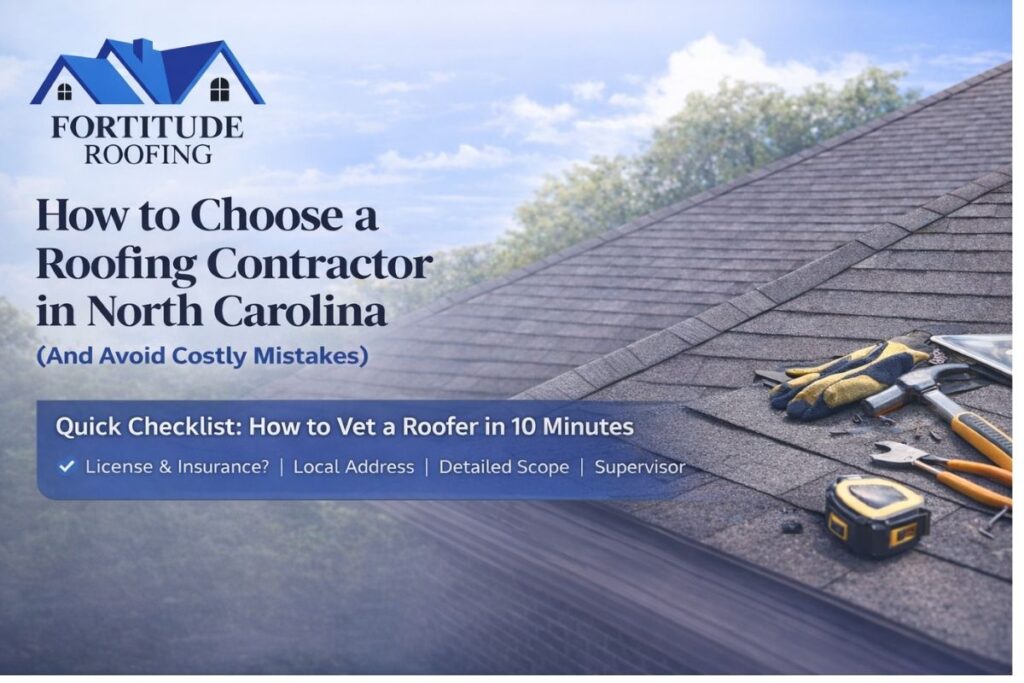
How to Choose a Roofing Contractor in North Carolina (And Avoid Costly Mistakes)
For homeowners in Carteret, Craven, Onslow, Pender, Brunswick, and New Hanover counties
Choosing a roofing contractor is one of the highest-leverage decisions you make after storm damage or when replacing a roof. The wrong choice commonly produces a predictable outcome: shortcuts at transitions and details, weak documentation, warranty friction, and expensive “mystery leaks” 12–36 months later.
This guide focuses on what actually matters in North Carolina: credentials, insurance, local accountability, scope discipline, and process maturity.
Quick Checklist: How to Vet a Roofer in 10 Minutes
Ask for (and verify) these five items before you discuss price:
- License number (if they claim to be licensed) and verify it in the NC Licensing Board database (North Carolina Licensing Board)
- Certificate of Insurance for general liability + workers’ comp (not a screenshot; request a COI)
- Physical North Carolina presence (address + how long in business locally)
- Written scope with material specs + flashing/ventilation plan (not “replace roof”)
- Named on-site supervisor and a clear change-order process
If they can’t produce these cleanly, move on.
Why Choosing the Right Roofer Matters More Than Price
A roof is not a commodity. It’s a system of water shedding + sealing + ventilation + edge detailing + flashing transitions. Most expensive failures originate at the parts homeowners don’t see: walls, chimneys, valleys, pipe boots, step flashing, and edge metal.
When a contractor is selected purely on price, the typical “savings” is recovered later through:
- leak diagnosis and interior repairs
- premature replacement due to system-level shortcuts
- warranty disputes (manufacturer and workmanship)
- claim friction because documentation doesn’t support the scope
Licensing in North Carolina: What Homeowners Should Know
The key rule (state threshold)
North Carolina’s general contractor statute defines a “general contractor” as someone who undertakes construction/improvement work when the cost of the undertaking is $40,000 or more. (Justia Law)
Practical implication:
- Many full roof replacements can approach or exceed that threshold depending on size, decking, steepness, and complexity.
- If your project is at or above that level, licensing is not “nice to have”—it’s foundational risk control. (Justia Law)
Penalties and why it matters after storms
The NC Licensing Board explicitly warns that out-of-state and unlicensed contractors often appear after disasters, and that contracting without the required license is illegal and can be criminally punishable. (North Carolina Licensing Board)
How to verify license status
Use the NC Licensing Board for General Contractors’ public license search to confirm:
- the company name matches the license
- the license is active
- the qualifier is current (North Carolina Licensing Board)
Insurance Coverage You Must Verify (Not Just “Trust”)
1) General liability insurance
This is what responds if the contractor damages your property (or a neighbor’s). Ask for a COI.
2) Workers’ compensation
North Carolina’s Industrial Commission notes that the Workers’ Compensation Act generally requires coverage for businesses with three or more employees. (N.C. Industrial Commission)
Even if a contractor claims “we use subs,” you still want clarity on coverage—because homeowner exposure is real when injuries occur.
Minimum standard: request a COI and confirm it is current.
Local Presence Is Not Optional After Storms
After major storms, the market attracts “storm chasers.” The NC Licensing Board specifically cautions homeowners about out-of-area and unlicensed operators during disaster recovery periods. (North Carolina Licensing Board)
What “local presence” should mean in practice:
- an established NC business address
- local permitting familiarity
- service capacity after the job (warranty calls, small fixes, documentation requests)
- references in your county (not “somewhere in the state”)
Reviews: How to Read Them Like an Adult
Star ratings are weak signals. Look for reviews that mention:
- how change orders were handled (decking, hidden damage)
- cleanliness and nail control
- communication cadence and schedule discipline
- follow-through after final payment
- warranty response behavior
Ignore one-off complaints. Pay attention to repeated patterns: missed appointments, surprise invoices, “couldn’t reach them afterward.”
The 8 Questions You Should Ask Before You Sign
- Who is the on-site supervisor and how often are they physically present?
- What is your flashing plan (walls, chimneys, valleys, pipe boots)—and is it in writing?
- What underlayment and deck water protection are you installing? (not “standard felt”)
- Will you pull permits when required, and who schedules inspections?
- How do you handle decking replacement if found during tear-off? (unit pricing + approval steps)
- What is your cleanup process? (magnetic sweeps, landscaping protection, dump trailer placement)
- What warranties do I receive—and who stands behind each one? (workmanship vs manufacturer)
- What payment schedule do you use and what triggers each draw? (avoid front-loaded schedules)
Clear, confident answers signal process maturity. Vague answers signal chaos.
If It’s Storm-Related: Why Insurance Process Competence Matters
Storm projects often require two skill sets:
- diagnosing roof system failures correctly
- documenting scope in a way that survives adjuster and carrier review
You are not hiring a “claims negotiator.” You’re hiring a contractor who can:
- produce construction-grade documentation
- identify scope omissions early
- support supplements when hidden damage or required details are discovered
Poor documentation doesn’t just delay payment—it can permanently narrow the approved scope.
Contract Terms That Prevent the Most Pain
Your contract should include, in plain language:
- full scope of work and all included components (vents, flashings, drip edge, ridge system, pipe boots)
- exact material specs (brand, line, weight/rating, underlayment type)
- decking replacement process and pricing
- change-order process (written approvals only)
- permit responsibility (contractor-owned)
- start date window + weather delay language
- cleanup standards and final walkthrough
- warranty terms and service response expectation
If the contract is one page and vague, you are underwriting risk you don’t understand.
Red Flags That Predict Bad Outcomes
Walk away if you see:
- pressure tactics (“sign today or price doubles”)
- cash-only or large upfront demands unrelated to material ordering
- refusal to provide license/insurance documentation
- no physical business presence in NC
- “we don’t need permits” as a blanket statement
- scope that avoids details (“replace roof” with no component list)
Final Takeaway
Choosing a roofing contractor in North Carolina is not about finding the fastest or cheapest option. It is about selecting a professional with verifiable credentials, real insurance coverage, local accountability, and a documented installation process.
If you want a planning-first evaluation in Carteret, Craven, Onslow, Pender, Brunswick, or New Hanover counties, Fortitude Roofing can provide a documented assessment and a scope that is designed to be defensible—technically and procedurally.