How to File an Insurance Claim for Roof Damage in Carteret County, NC
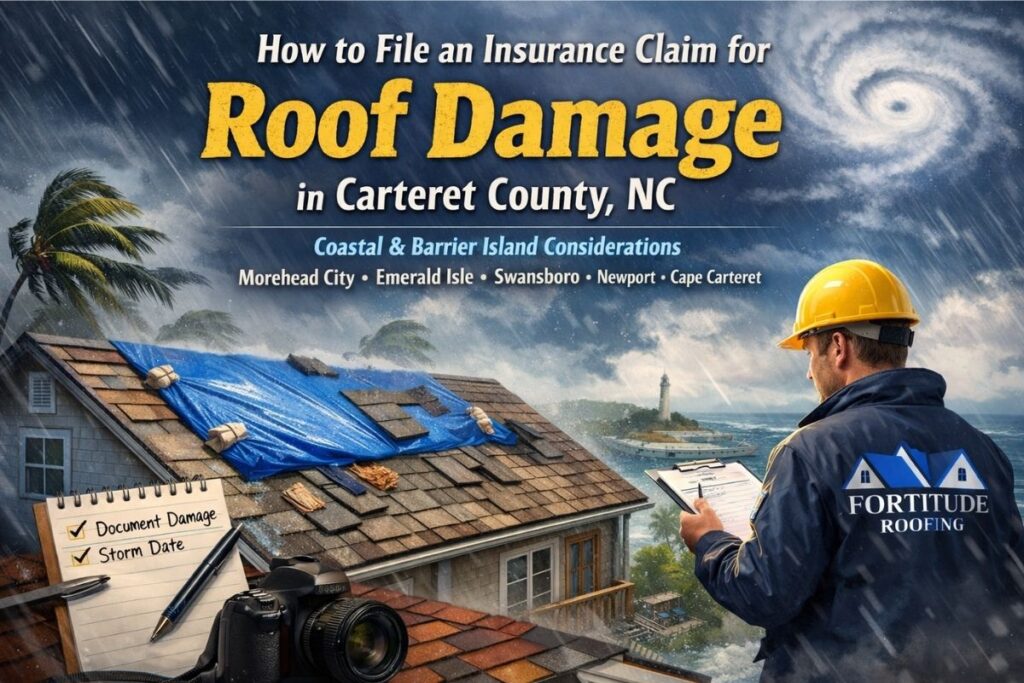
How to File an Insurance Claim for Roof Damage in Carteret County, NC
Coastal & Barrier Island Considerations (Morehead City, Emerald Isle, Swansboro, Newport, Cape Carteret)
Roof insurance claims in Carteret County often require more discipline than inland markets because coastal exposure changes how roofs fail. Salt air, sustained winds, hurricane-force gusts, and wind-driven rain routinely create uplift damage (broken seals, lifted tabs, creases) that may not leak immediately. That’s why many homeowners delay action—then lose documentation clarity or miss the best window to prove storm causation.
This guide explains how roof claims typically work in Carteret County, what makes coastal claims different, and how to protect your property and your claim after a storm.
Fortitude Roofing serves Carteret County, including Morehead City, Emerald Isle, Swansboro, Newport, and Cape Carteret.
Quick Answer: Roof Insurance Claims in Carteret County
In Carteret County, roof damage claims are most commonly tied to wind events and wind-driven rain intrusion, not roof age alone. Because coastal roofs can show mixed conditions (storm impact plus baseline aging), prompt inspection and slope-by-slope documentation are critical—even if there is no leak.
Many coastal properties may be insured through specialized wind structures (including the North Carolina Joint Underwriting Association, often referred to as the “Beach Plan”) or policies with separate wind terms. These can involve different deductibles and documentation expectations than standard homeowners coverage, so homeowners should reference their policy documents.
Why Carteret County Claims Are Different
Carteret County roofs face two realities that affect claims outcomes:
- Wind damage can be subtle and non-leaking at first
Broken seal strips, lifted tabs, and creases may not show from the ground. - Salt exposure accelerates component degradation
Corrosion and material fatigue can make it harder to separate storm-driven change from baseline deterioration unless documentation is strong and tied to a specific event.
Barrier island and near-coastal homes are especially susceptible due to open exposure and higher gust potential.
Common Roof Damage Patterns in Carteret County
After coastal wind events, professionals commonly find:
- Shingle lifting and seal-strip failure (often slope-dependent and edge/ridge concentrated)
- Creases and displaced tabs consistent with uplift forces
- Fastener and metal component corrosion accelerated by salt exposure
- Flashing displacement at chimneys, walls, and roof transitions
- Wind-driven rain intrusion through vulnerable details, even without missing shingles
In many cases, the roof’s damage “story” is told by distribution patterns across slopes—not a single dramatic missing-shingle area.
Insurance Policies Common in Carteret County (What to Know Before You File)
Coastal policies vary widely. Some homeowners may have wind coverage structured differently than inland policies (including specialized wind/hail structures).
Common practical realities include:
- Higher wind deductibles than standard all-peril deductibles
- More restrictive definitions of what constitutes covered wind damage versus wear
- Greater emphasis on documentation, storm date clarity, and evidence of sudden change
You do not need to memorize insurance language. You do need to confirm:
- which deductible applies to the storm type, and
- what the policy requires for notice/reporting and documentation.
When in doubt, rely on your official policy documents and carrier guidance.
Step-by-Step: What to Do After a Storm in Carteret County
Step 1: Protect the Property (Emergency Mitigation)
If you have active leaking:
- contain water and protect interior contents,
- document interior staining and active drips,
- use temporary measures (tarping) if needed.
Avoid permanent repairs before documentation is complete unless property protection requires it.
Step 2: Document Like a Professional (Slope-by-Slope)
Coastal claims are often won on documentation quality. Capture:
- wide photos of each roof slope (front/back/left/right or N/S/E/W),
- close-ups of lifting, creases, broken seals, missing pieces, displaced ridge caps,
- ridge and edge zones (rakes, eaves, hips, ridge caps),
- flashing and penetrations (chimneys, vents, skylights, wall transitions),
- collateral evidence (gutters, screens, soft metals, siding impacts),
- interior evidence (staining, wet insulation) with dates.
If you document only one “bad spot,” you lose the pattern and exposure logic that coastal roofs often require.
Step 3: Choose and Preserve the Storm Date Narrative
In Carteret County, multiple storms can occur in a short window. Don’t blur them together.
- Identify the likely storm date(s).
- Note when conditions changed (leak onset, shingles noticed lifted, debris impacts).
A clean claim usually has one anchor date and a consistent evidence package.
Step 4: Get a Coastal-Experienced Roof Inspection
A strong inspection should produce:
- slope-by-slope labeled photos,
- pattern analysis (windward vs leeward, ridge/edge concentration),
- repairability commentary when relevant (brittleness, seal failure, matchability),
- clear separation of storm-driven change vs baseline wear.
Ground-only assessments commonly miss uplift damage that matters later.
Step 5: Review Your Deductible and Coverage Structure
Before filing, confirm:
- whether the deductible is wind/hurricane-specific,
- whether the claim threshold makes sense financially,
- any reporting/notice requirements.
This prevents filing a claim that can’t clear the deductible or that lacks documentation support.
Step 6: File the Claim With the Carrier Once Damage Is Identified
When you file:
- provide the storm date,
- describe what changed (missing shingles, leak onset, uplift indicators),
- avoid speculation beyond what you can document.
Step 7: Prepare for the Adjuster Inspection
Be present or have your contractor present to:
- ensure all slopes and high-risk zones are reviewed,
- share slope-by-slope documentation and notes,
- point out pattern evidence and collateral indicators.
This is not confrontation. It’s ensuring the adjuster sees the full roof system, not only the easiest areas to view.
Step 8: Expect Supplements (This Is Normal)
Initial scopes often differ from what’s required to build the roof correctly in real coastal conditions. Supplements are resolved through:
- photos tied to specific line items,
- documented concealed conditions (decking/fasteners) discovered during tear-off,
- manufacturer requirements where applicable,
- clear explanation of why the original scope cannot restore pre-loss performance.
Documentation wins. Emotion loses.
What Not to Do (Common Carteret County Claim Mistakes)
Avoid these patterns that create preventable denials or friction:
- waiting for leaks to appear before inspecting,
- waiting weeks/months after a storm to document,
- mixing multiple storm dates without a clean narrative,
- filing without a slope-by-slope inspection,
- approving permanent repairs before documentation (except true emergency mitigation),
- assuming the adjuster will find subtle uplift damage without evidence.
FAQs
Should I file a claim if I don’t have a leak?
Possibly. Coastal wind can break seals and lift shingles without immediate leaks. The right first step is usually a professional inspection and documentation to determine whether storm-related damage exists.
What roof damage is most common after coastal wind events?
Uplift-related issues—lifted tabs, broken seals, creases, ridge/edge failures—plus flashing displacement and wind-driven rain intrusion at vulnerable details.
Why does the storm date matter so much in Carteret County?
Because multiple storms can occur in the same season. A claim is stronger when the damage can be tied to a specific event window and documented as a sudden change.
Are Beach Plan or wind-structured policies different?
They can be. Deductibles and coverage terms may differ from standard homeowners policies, and documentation expectations can be stricter. Always reference your policy documents and carrier guidance.
Can my roofing contractor negotiate my claim?
Contractors can provide construction observations, photos, documentation, and repair/replacement requirements. Claims decisions and policy interpretation remain with the carrier.
Final Takeaway
Carteret County roof claims are often decided by inspection quality, pattern-based documentation, and a clean date-of-loss narrative—not by whether the roof is leaking today. Coastal wind uplift damage can be subtle, and salt exposure complicates causation. The best outcomes come from prompt inspection, slope-by-slope evidence, and a professional, documentation-first adjuster meeting.
Serving Carteret County Homeowners
Fortitude Roofing serves homeowners across Morehead City, Emerald Isle, Swansboro, Newport, and Cape Carteret, providing inspection and documentation with a focus on storm resilience, coastal exposure realities, and long-term performance.
Author and Review
Reviewed by: Fortitude Roofing (Carteret County / Coastal NC)
Educational content only. Coverage depends on policy language, endorsements, deductibles, and carrier determinations.