Residential vs Commercial Roofing: Key Differences Property Owners Should Understand
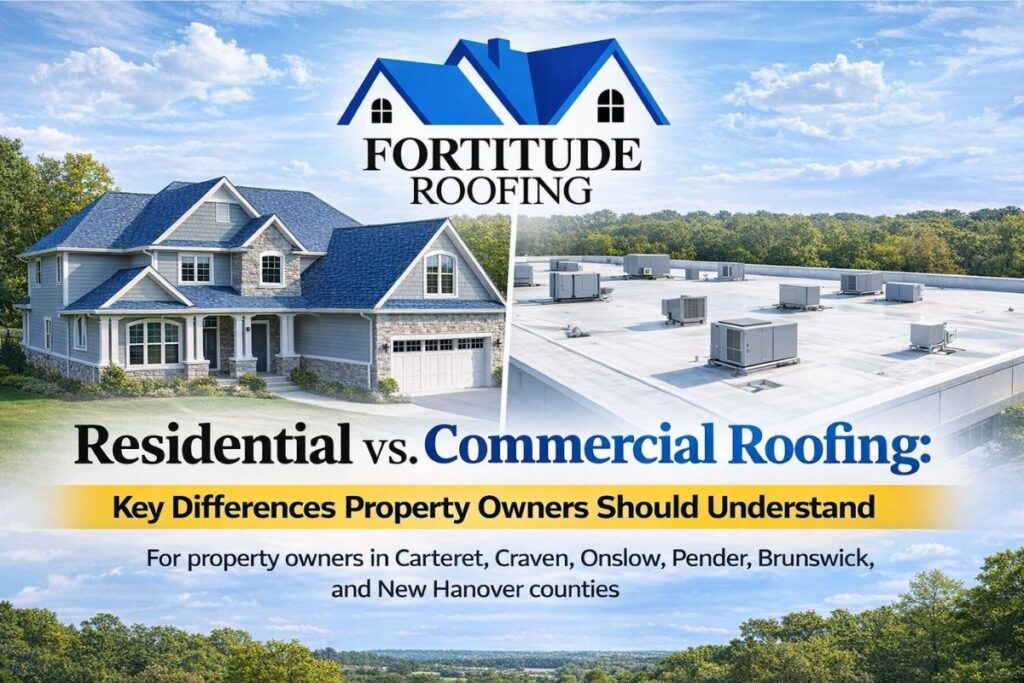
Residential vs. Commercial Roofing: Key Differences Property Owners Should Understand
For property owners in Carteret, Craven, Onslow, Pender, Brunswick, and New Hanover counties
Residential and commercial roofing are often grouped together, but they are fundamentally different in design, materials, failure modes, maintenance requirements, and decision criteria. Property owners who understand these differences make better choices on repairs, replacements, budgeting, and contractor selection.
This guide explains the key distinctions—and why they matter in North Carolina’s wind, rain, humidity, and storm cycles.
Quick Answer: What’s the Biggest Difference?
- Residential roofing is mainly about water shedding (gravity does most of the work).
- Commercial roofing is mainly about waterproofing and drainage control (because water sits longer and details carry more risk).
That difference drives everything else: materials, installation method, maintenance, and how problems show up.
Structural Differences Between Residential and Commercial Roofs
Residential roofs typically:
- are steep-slope / pitched
- shed water rapidly
- use shingles or metal panels
- have many architectural details (valleys, dormers, ridges)
- fail most often at transitions and penetrations (flashings, walls, chimneys, pipe boots)
Commercial roofs are usually:
- flat or low-slope
- depend on drainage systems (scuppers, drains, gutters, tapered insulation)
- often support rooftop equipment (HVAC, exhaust fans)
- have larger uninterrupted fields but higher detail risk at seams, terminations, penetrations, and drains
- fail most often from ponding water, seam issues, and neglected maintenance
Material Differences
Common residential roofing materials
- asphalt shingles (3-tab, architectural)
- impact-resistant shingles (region- and budget-dependent)
- metal roofing systems (exposed fastener or standing seam)
- tile and specialty systems (less common, higher cost)
These materials prioritize a balance of appearance, wind resistance, and lifespan.
Common commercial roofing materials
- TPO or PVC single-ply membranes
- EPDM (rubber) systems
- modified bitumen
- built-up roofing (BUR)
- coatings (often as restoration strategies, not universal solutions)
These systems prioritize waterproofing performance, seam integrity, and detailing around penetrations and drains.
Installation and Maintenance Requirements
Residential roofs
- install relatively quickly (crew size and complexity drive schedule)
- require periodic inspections, especially after storms
- are often evaluated by visible condition and age
- depend heavily on correct flashing and ventilation strategy
Commercial roofs
- require specialized crews and detail discipline
- involve more planning: drainage, penetrations, rooftop traffic paths
- should follow a maintenance schedule (often semi-annual + post-storm)
- benefit from documented inspections for budgeting, warranty, and risk management
Maintenance neglect is a leading cause of commercial roof failure because small seam or drain issues become big leaks over time.
Code, Permitting, and Inspection Differences
Commercial projects often involve:
- stricter code pathways and more formal inspection requirements
- occupancy and safety considerations
- engineering inputs for wind uplift, loading, and penetrations (project-dependent)
- documentation requirements that exceed typical residential expectations
Residential projects are usually simpler, but code compliance still matters—especially when decking, ventilation, or structural elements are involved.
Cost and Lifespan Considerations
Residential roofs
- lower overall cost (smaller footprint, simpler access)
- lifespan varies by material, ventilation, exposure, and installation quality
- replacement often driven by age, storm events, or repeated leaks
Commercial roofs
- higher upfront cost (material systems + detailing + drains + access logistics)
- longer life is achievable with correct installation and consistent maintenance
- replacement decisions are performance-driven: leakage frequency, wet insulation, seam degradation, ponding, and lifecycle economics
For commercial properties, the best operators plan roofs as capex + maintenance, not “replace when it leaks.”
How Problems Show Up: Residential vs. Commercial
Residential leak patterns
- often originate at flashings, valleys, penetrations, or wind-damaged shingle seals
- leaks may travel inside the assembly and show up far from the entry point
Commercial leak patterns
- often originate at seams, terminations, penetrations, drain bowls, or ponding zones
- leaks may be intermittent and weather-dependent (wind direction, rain volume, ponding duration)
In both cases, the stain location is often misleading—but commercial systems are especially deceptive because water can migrate across larger areas.
Why Contractor Experience Matters (and how to verify it)
Not all contractors are equipped for both categories. Property owners should verify:
- System-specific experience (steep-slope shingle/metal vs low-slope membrane)
- Material certifications (especially for manufacturer warranty eligibility)
- Project management capability (safety, access, staging, scheduling)
- Maintenance support (particularly for commercial roofs)
- Documentation maturity (photos, moisture findings, repair logs)
System expertise is a performance variable, not a nice-to-have.
FAQs: Residential vs. Commercial Roofing
Is commercial roofing just a bigger version of residential roofing?
No. Commercial roofs are usually low-slope waterproofing systems with seams, drains, and terminations that require different materials, detailing, and maintenance.
What lasts longer—residential or commercial roofs?
Commercial roofs can last a long time with documented maintenance, but neglect can shorten life dramatically. Residential roof life depends heavily on material, ventilation, and installation quality.
Why do commercial roofs need regular maintenance?
Because seam, drain, and penetration issues can develop without obvious visible symptoms and can create large wet-insulation zones before leaks show inside.
Can the same roofer do both residential and commercial?
Some can, many cannot. Verify system-specific experience and manufacturer credentials for the roof type you own.
Final Takeaway
Residential and commercial roofing serve different purposes and require different expertise. Understanding the differences helps property owners:
- choose the right system and materials
- hire the right contractor (and avoid costly mismatches)
- plan maintenance and budgeting realistically
If you own or manage property in Carteret, Craven, Onslow, Pender, Brunswick, or New Hanover counties, Fortitude Roofing can provide a system-specific evaluation—residential or commercial—focused on clarity, documented findings, and long-term performance.