Signs Your Roof Has Hail Damage (That Homeowners Commonly Miss)
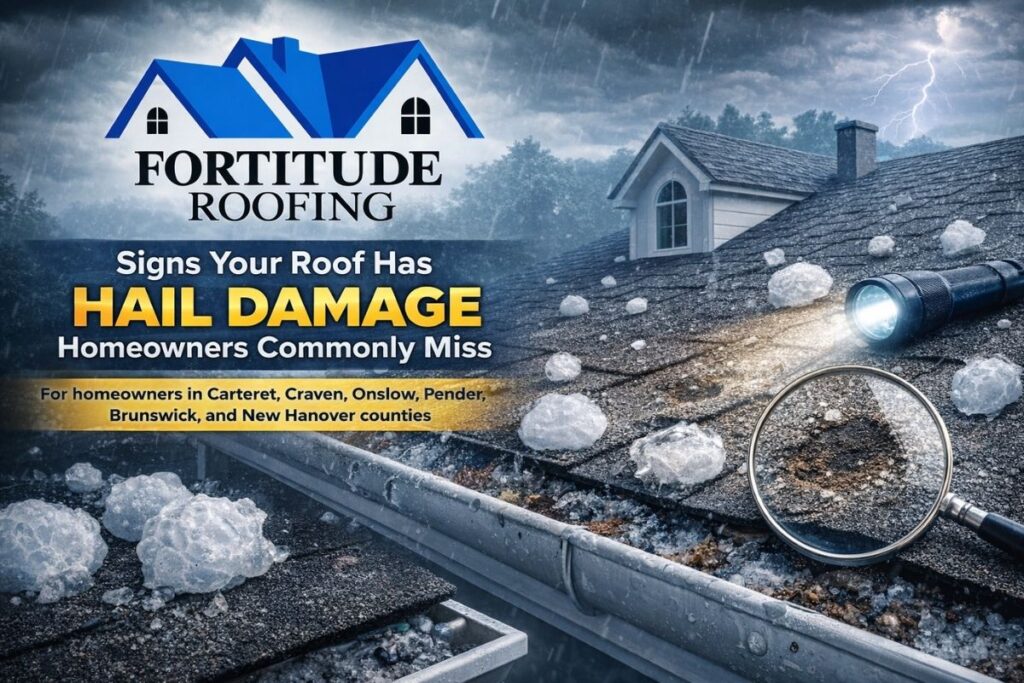
Signs Your Roof Has Hail Damage Homeowners Commonly Miss
For homeowners in Carteret, Craven, Onslow, Pender, Brunswick, and New Hanover counties
Hail damage is one of the most misunderstood roofing issues. A roof can look “fine” from the ground yet have impact damage that shortens shingle life, weakens water-shedding performance, and makes insurance claims harder later.
This guide covers the hail-damage indicators homeowners often miss—especially in North Carolina—and when a professional inspection is the prudent move.
Quick Answer: What Are the Most Common “Hidden” Signs of Hail Damage?
The most commonly missed signs are:
- granule loss (bare/dark spots; unusual granules in gutters)
- shingle bruising (soft spots you can’t see from the ground)
- dented metal (vents, flashings, gutters, downspouts, drip edge)
- impact patterns across multiple slopes (not just one visible area)
- delayed interior symptoms (stains, damp insulation, musty odors)
Why Hail Damage Gets Overlooked
Hail damage is deceptive because:
- shingles may not be missing or torn
- damage is often scattered, not uniform
- symptoms can be delayed (months later)
- many claim outcomes worsen when reporting is late and damage is interpreted as aging or wear
Exterior Signs of Hail Damage Homeowners Commonly Miss
1) Granule loss on shingles
Granules protect shingles from UV and heat. Hail impacts can knock granules loose, exposing the asphalt mat underneath.
Look for:
- bare, darkened, or shiny spots where granules are missing
- granule buildup in gutters/downspouts beyond normal seasonal shedding
Why it matters: granule loss accelerates aging and can materially shorten service life.
2) Bruising or “soft spots” you won’t see from the ground
Hail can fracture the shingle mat without visibly breaking the surface. That bruising compromises performance even if the shingle looks intact.
Common characteristics:
- often invisible from the yard
- may feel soft, spongy, or dimpled on close inspection
- can weaken water resistance and speed deterioration
3) Dented metal components (high-signal evidence)
Hail often shows up more clearly on metal than on shingles. If metal is dented, the roof likely experienced meaningful hail exposure—even if shingles don’t look dramatic.
Check for dents on:
- vent caps and turbine vents
- flashing edges and counterflashing
- drip edge
- ridge vent end caps / metal ridge components
- gutters and downspouts
4) Impact marks on soft metals and coated surfaces
You may also see impact indicators on:
- painted fascia metal
- AC condenser fins (collateral indicator)
- outdoor fixtures, mailboxes, or cars (not roofing, but event confirmation)
Collateral impacts help establish that a real hail event occurred at your location—useful when timing and attribution matter.
Interior Warning Signs People Misattribute
Hail damage does not always leak immediately. Interior symptoms can appear later after repeated rain cycles.
Watch for:
- ceiling stains that appear weeks/months later
- attic moisture or darkened roof decking
- damp insulation
- musty odors near top-floor ceilings or attic corners
Practical reality: once interior signs appear, the scope is often more advanced and more expensive.
Why Delayed Action Hurts Insurance Claims
Most insurers expect hail claims to be:
- prompt
- tied to a dated storm/event
- supported by documentation (photos, slope notes, collateral impacts)
Delays commonly lead to:
- attribution disputes (“old damage” vs. storm damage)
- denials based on wear and tear arguments
- reduced settlement scope due to uncertainty
In North Carolina, hail events are often regional. Carriers typically compare your report date and narrative to known storm activity, so timing and documentation matter.
When to Schedule a Professional Roof Inspection
Consider an inspection when:
- a hailstorm passed through your area (even if it seemed small)
- neighbors report roof/gutter damage
- you see dents on vents, gutters, downspouts, or drip edge
- your roof is 7–10+ years old (less impact tolerance)
- you’re planning to sell or refinance and want risk reduced
A professional can identify impact patterns and functional damage homeowners cannot reliably assess from the ground.
What a Proper Hail Inspection Should Include
A decision-grade hail inspection typically includes:
- evaluation of shingle surface condition and flexibility
- impact patterns across all slopes (not just one area)
- assessment of flashings, penetrations, ridge details, and vents
- attic view (when accessible) for moisture paths and decking condition
- photo documentation suitable for insurance review
- clear notes on slope count, elevations, and collateral impacts
The difference between a useful inspection and a weak one is repeatable evidence, not opinion.
Common Myths About Hail Damage
“If it’s not leaking, it’s fine.”
Not necessarily. Many failures progress internally and worsen through heat cycling and storms.
“Cosmetic damage doesn’t matter.”
Sometimes true, often not. “Cosmetic” impacts can become functional issues as granule loss and mat fractures age.
“Insurance won’t cover it anyway.”
Coverage depends heavily on timing, documentation, and policy language. Many valid claims fail on process, not merit.
FAQs: Hail Damage in North Carolina
Can hail damage a roof without breaking shingles?
Yes. Hail can bruise the shingle mat and remove granules without creating obvious tears.
What is the easiest hail damage clue to spot from the ground?
Dents on metal components—gutters, downspouts, vents, flashing edges—are often the most visible.
How soon should I get my roof inspected after hail?
As soon as practical after a known hail event. Early documentation reduces attribution disputes and scope gaps.
Will hail damage always cause leaks right away?
No. Leaks often show up later after repeated rain cycles and material degradation.
Final Takeaway
Hail damage is not always obvious—but it is rarely harmless. In North Carolina’s climate, identifying and documenting hail impacts early can protect both roof performance and the homeowner’s financial position. When in doubt, evaluation is typically safer—and cheaper—than assumption.