Standing Seam Metal Roofing in Wilmington & Leland, NC: Installation, Cost, and Is It Worth It?
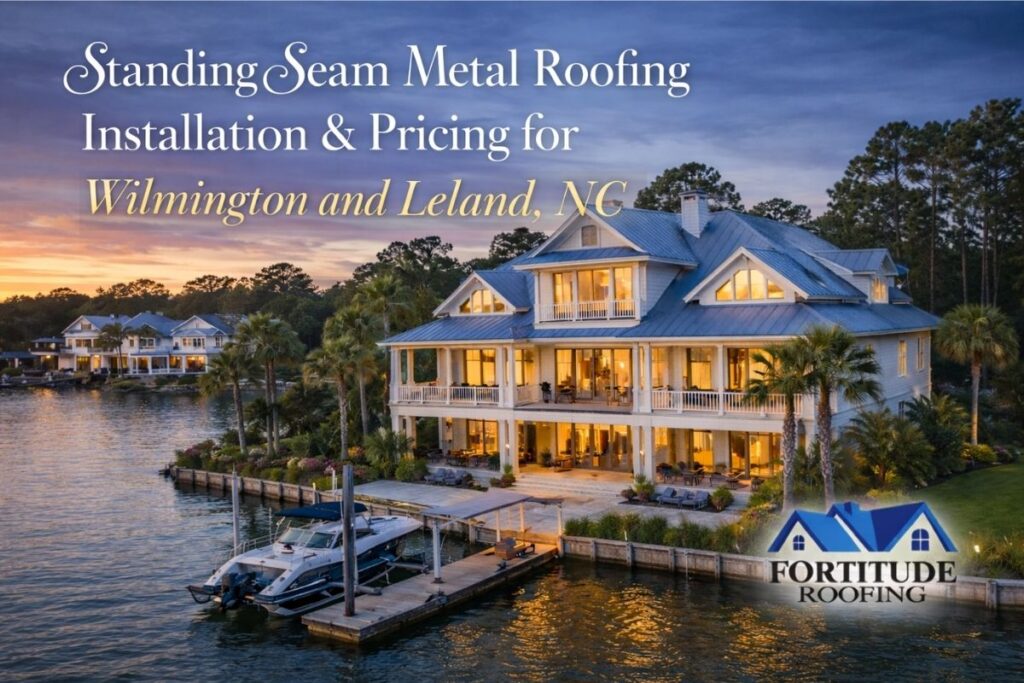
Standing Seam Metal Roofing in Wilmington & Leland, NC: Installation, Cost, and Is It Worth It?
If you’re considering a standing seam metal roof in Wilmington, Leland, or surrounding coastal communities in New Hanover and Brunswick Counties, you’re likely prioritizing long-term durability, storm performance, and reduced maintenance in a demanding coastal climate.
Standing seam metal roofing is one of the most premium residential roofing systems available in Southeastern North Carolina. When designed and installed correctly, it’s also one of the most resilient.
This guide explains what standing seam metal roofing is, how installation works, what it typically costs in the Wilmington–Leland market, and when it makes financial sense.
Standing Seam Metal Roofing — Wilmington & Leland Quick Facts
- Average lifespan: 40–70 years
- Typical installed cost (2025): Mid-teens to $20s per square foot
- Best for: Long-term homeowners, coastal exposure, low maintenance priorities
- Common materials: Galvalume steel, aluminum
- Fasteners: Concealed (reduced long-term leak risk vs exposed-fastener systems)
Quick Answer: Is Standing Seam Metal Roofing Worth It in Wilmington and Leland?
For many homeowners in Wilmington, Leland, and nearby coastal areas, standing seam metal roofing is worth the investment when long-term ownership, storm resilience, and lower maintenance matter more than the lowest upfront price.
While standing seam costs more initially than asphalt shingles, a properly installed system commonly lasts 40–70 years, with premium materials sometimes exceeding that range. For homeowners planning to stay in their home long-term, it can reduce the likelihood of ever needing another roof replacement.
What Is Standing Seam Metal Roofing?
Standing seam metal roofing is a concealed-fastener roofing system made from vertical metal panels that lock together with raised seams running continuously from ridge to eave.
Compared to exposed-fastener metal roofs, standing seam systems typically:
- Hide screws and fasteners, reducing long-term leak risk
- Allow for controlled thermal expansion and contraction
- Provide strong water-shedding and wind performance when engineered correctly
Common standing seam profiles include snap-lock and mechanically seamed systems. Each has different performance characteristics, installation requirements, and use cases depending on roof design and exposure.
Key Benefits in Coastal North Carolina
Homeowners throughout Wilmington, Leland, and the Cape Fear region often choose standing seam metal roofing for the following reasons:
Longevity
Standing seam systems are commonly cited in the 40–70 year lifespan range when installed correctly, depending on metal type, coating system, detailing, and maintenance.
High-Wind Performance
Standing seam is frequently selected for coastal and high-wind environments because panels interlock and fastening strategies differ significantly from shingle systems. Actual performance depends on profile selection, attachment method, and detailing.
Lower Maintenance vs Exposed-Fastener Metal
Concealed-fastener systems avoid the recurring fastener back-out and washer deterioration issues common with exposed-fastener metal roofs.
Premium Appearance and Resale Appeal
Standing seam is widely viewed as a premium exterior upgrade, particularly for higher-end and coastal homes.
Standing Seam Metal Roof Installation Process
Standing seam is a precision roofing system. The material is premium; the outcome depends on design discipline and installation execution.
A professional installation typically includes:
- Roof inspection and detailed measurement
- Tear-off (often recommended in coastal North Carolina to verify decking and detailing)
- High-performance underlayment appropriate to roof design and exposure
- Panel fabrication and layout planning
- Panel installation (snap-lock or mechanical seam per manufacturer specifications)
- Custom flashing and trim at walls, chimneys, valleys, ridges, and eaves
- Final inspection and cleanup
If a contractor cannot clearly explain their approach to underlayment, penetrations, and flashing details, that’s a risk signal—not a minor detail.
Standing Seam Metal Roof Cost in Wilmington and Leland, NC
Pricing varies with material markets, roof complexity, and labor availability, especially after storm seasons. The most accurate number comes from an on-site evaluation, but homeowners still need realistic expectations.
Typical Installed Cost Ranges (2025)
| System Type | Typical Installed Cost (per sq ft) | Notes |
| Galvanized Steel Standing Seam | Mid-teens to low $20’s | Most common coastal option |
| Aluminum Standing Seam | High teens to mid-$20’s | Improved corrosion resistance |
| Premium/Complex Roofs | $25+ | Mechanical seam, heavy detailing |
National cost data commonly places standing seam installations in the high teens to low-to-mid $20s per square foot, depending on scope and assumptions. Broader consumer guides often cite ranges from $10 to $30+ per square foot, depending on metal type, profile, and complexity.
Practical takeaway for Wilmington–Leland homeowners:
If you want a roof built as a true coastal-grade system—with tear-off, proper underlayment, correct flashing, and integrated ventilation when applicable—you should expect pricing to commonly land in the mid-teens to $20s per square foot installed for steel or aluminum systems. Premium metals and complex roof designs will be higher.
What Drives the Final Cost?
Standing seam pricing is most influenced by:
- Roof size and complexity (hips, valleys, dormers, transitions)
- Panel type (snap-lock vs mechanical seam)
- Metal type and thickness (steel vs aluminum vs copper)
- Roof pitch and access difficulty
- Flashing and penetration complexity
- Decking repairs discovered during tear-off
- Edge, fascia, gutter, and water-management detailing
Is Standing Seam Metal Roofing Financially Worth It?
Standing seam tends to make the most sense when at least one of the following is true:
- You plan to own the home long-term (often 10+ years)
- You want to minimize the probability of re-roofing again
- You value storm resilience and lower maintenance over lowest upfront cost
- Your home’s value and architecture support a premium roofing system
When Standing Seam May Not Be the Right Choice
Standing seam may not be ideal if you expect to sell soon, or if your roof geometry is extremely complex and you’re unwilling to pay for the detailing required to execute the system correctly.
Why Fortitude Roofing for Standing Seam in Wilmington and Leland?
Fortitude Roofing designs and installs metal roofing systems for Southeastern North Carolina’s coastal exposure using an operator-grade approach:
- System design and detailing—not “panels only” installs
- Coastal-appropriate material and fastening strategies
- Experienced crews and controlled jobsite execution
- Clear scope definition and transparent pricing
We don’t sell roofs. We design long-term roofing systems built for coastal conditions.
FAQ: Standing Seam Metal Roofing in Wilmington and Leland
How long does standing seam metal roofing last?
Commonly 40–70 years depending on metal type, coating, installation quality, and maintenance.
Is standing seam metal roofing louder in rain?
When installed over solid decking with proper underlayment, most homeowners report noise levels comparable to other systems.
Does metal roofing rust in coastal areas?
Quality panels with appropriate coatings and correct fastener selection are widely used in coastal environments. Performance depends on product choice and detailing.
Can standing seam be installed over shingles?
Sometimes, but full tear-off is often recommended in coastal North Carolina to confirm decking condition and build the system correctly from the substrate up.
Schedule a Standing Seam Metal Roofing Estimate in Wilmington or Leland
If you’re considering standing seam metal roofing in Wilmington, Leland, or nearby coastal communities, the next step is a roof-specific evaluation and a scope you can trust.
Fortitude Roofing will assess your roof, explain profile and material options, and provide transparent pricing so you can make a confident, informed decision.