What Insurance Adjusters Look for During a Roof Inspection (And What They Often Miss)
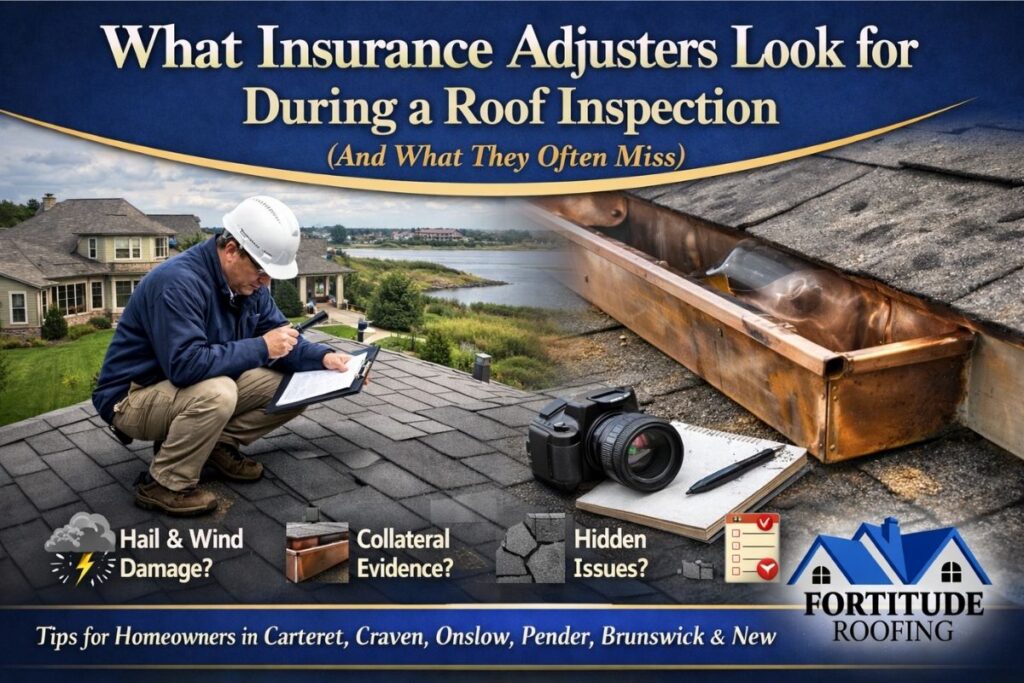
What Insurance Adjusters Look for During a Roof Inspection (And What They Often Miss)
For homeowners in Carteret, Craven, Onslow, Pender, Brunswick, and New Hanover counties
When you file a roof insurance claim, the outcome often hinges on one event: the adjuster’s inspection. Many homeowners assume adjusters evaluate a roof the same way a roofing professional does. In practice, an adjuster is conducting a coverage and scope inspection under time, process, and documentation constraints—not a “best practices” roof evaluation.
This guide explains what adjusters typically look for, what they often miss, and how North Carolina homeowners can reduce under-scoping risk through preparation and documentation.
Quick Answer: What Do Adjusters Look For?
Most adjusters are evaluating four things:
- Proof a covered event occurred (storm-linked evidence)
- Visible damage consistent with that event
- Collateral impacts that confirm severity (metal dents, exterior damage)
- Policy application (storm damage vs. wear/maintenance exclusions)
They are not usually running a full roof-system diagnostic. They are validating coverage + scope.
The Adjuster’s Role (and the Limits That Create Gaps)
An adjuster’s job is to:
- verify a covered event occurred
- observe and document visible damage
- apply policy language to determine scope and payout
Common constraints include:
- high inspection volume after storms
- standardized carrier checklists and sampling methods
- limited time per property
- visual-first assessments (hands-on evaluation may be minimal)
This is how under-scoped claims happen without anyone “doing something wrong.” The process is designed for efficiency, not perfection.
What Adjusters Commonly Evaluate During a Roof Inspection
1) Visible shingle damage (high-signal items)
Adjusters commonly look for:
- missing shingles
- creased or lifted shingles (wind)
- obvious punctures or impact marks
- exposed underlayment or torn edges
Easy to miss: subtle hail impacts and wind-lift that “settles back down” after breaking the seal.
2) Collateral damage (event confirmation)
Adjusters often check:
- gutters and downspouts
- vent caps and ridge components
- flashing edges and metal trim
- siding, screens, and exterior fixtures
Collateral damage matters because it helps confirm the storm’s intensity at your property—even if roof damage is harder to spot quickly.
3) Roof age and overall condition (wear vs. event)
Adjusters may evaluate:
- approximate roof age
- granule loss patterns and brittle shingles
- prior repairs (patchwork or mismatched materials)
- indicators that issues could be long-standing
Older roofs often face more scrutiny because carriers separate storm damage from aging/deterioration.
4) Interior evidence (supporting, not primary)
Interior staining, attic moisture, or wet insulation can support timing and severity. But many inspections remain exterior-led, with interior evidence treated as supplemental.
What Adjusters Often Miss (and Why It Changes Claim Outcomes)
1) Subsurface hail bruising
Hail can fracture the internal shingle mat without obvious surface breaks. This type of damage:
- weakens the shingle
- accelerates granule loss and aging
- may not leak immediately
- is easy to miss without close, hands-on inspection
Result: homeowners sometimes hear “no hail damage found” even when performance is compromised.
2) Pattern-based damage across slopes and elevations
Storm damage is rarely uniform. Limited sampling can miss:
- wind damage concentrated on one elevation
- hail swaths affecting certain slopes more than others
- ridge and hip vulnerabilities (common uplift zones)
- perimeter/edge failures that aren’t visible from the yard
If only one area gets thorough attention, the scope can be incomplete.
3) Code-driven scope items
Local code and permit requirements can affect how a roof must be rebuilt. These items can be omitted unless they’re specifically identified and documented.
If code items are missed early, the claim can become under-funded until corrected through documentation and supplements.
4) Matching and repair feasibility (discontinued shingles)
Insurance aims to restore the roof to pre-loss condition. If shingles are discontinued or cannot be reasonably matched, a “repair” may not restore the system.
If matching is not raised during inspection, adjusters may default to repair scope—creating downstream disputes.
Why Contractor Presence Matters During the Adjuster Inspection
A knowledgeable roofing contractor can:
- identify directional wind patterns and slope exposure issues
- point out subtle functional failures (not just obvious damage)
- ensure flashings, penetrations, ridge, and edges are evaluated
- translate findings into clear photos and notes
- help align the scope to actual conditions
This is not about confrontation. It is about completeness and preventing avoidable omissions.
How Homeowners Can Prepare for an Adjuster Inspection
Use this sequence:
1) Document before the inspection
- exterior photos/video from the ground (all elevations)
- interior photos of stains, bubbling paint, attic moisture (if safe)
- close-ups of collateral dents (gutters, vents, metal trim)
2) Capture the storm window
- note the date/time range of the event
- save weather alerts or neighborhood notices (basic support for timing)
3) Avoid permanent repairs beforehand
- do temporary mitigation if needed (tarps, leak capture)
- photograph before/after mitigation
- keep receipts
4) Ensure access
- unlock gates and clear staging areas
- provide attic access if safe and relevant
5) Have a contractor present (if possible)
Especially for hail claims, multi-slope damage, or complex roofs.
Common Misunderstandings That Hurt Claims
“If the adjuster doesn’t see it, it’s not covered.”
Not necessarily. Additional documentation, supplements, and reinspections can correct scope when justified.
“Cosmetic damage doesn’t matter.”
Sometimes true, often not. Cosmetic-looking hail impacts can become functional failure as granule loss and mat fractures progress.
“Denials are final.”
Many decisions change after stronger evidence, reinspections, or corrected scope—especially when pattern damage or key items were missed initially.
Final Takeaway
Adjusters follow structured processes, but those processes have limits. Understanding what adjusters look for—and what they often miss—helps homeowners approach roof claims with better preparation, stronger documentation, and fewer preventable scope shortfalls.
If you’re in Carteret, Craven, Onslow, Pender, Brunswick, or New Hanover counties, Fortitude Roofing can provide a professional inspection and documentation review before or after an adjuster visit—focused on accuracy and clarity, not pressure.