What Is a FORTIFIED™ Roof — and Is It Worth It in North Carolina?
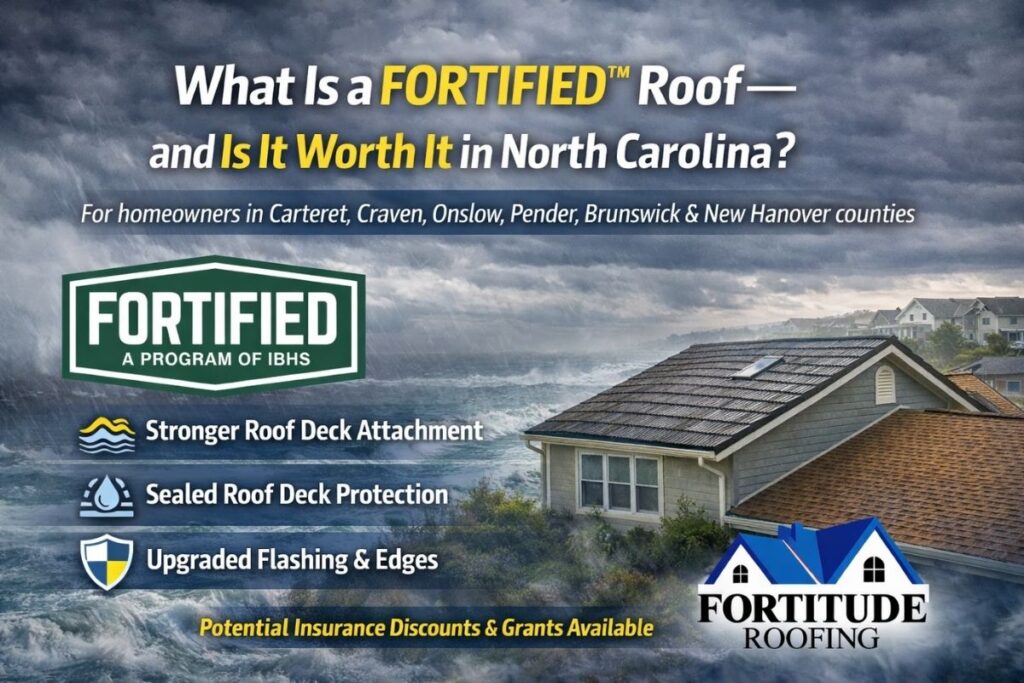
What Is a FORTIFIED™ Roof — and Is It Worth It in North Carolina?
For homeowners in Carteret, Craven, Onslow, Pender, Brunswick, and New Hanover counties
Homeowners across storm-exposed North Carolina hear “FORTIFIED™ roof” more often after major weather events—but many are unclear on what it actually is, how it differs from a standard roof, and whether the added investment is justified.
This guide explains the FORTIFIED Roof™ designation in practical terms and gives a decision framework for North Carolina homeowners.
Quick Answer: What is a FORTIFIED™ Roof?
A FORTIFIED™ roof is not a shingle brand. It is a voluntary construction and re-roofing standard created by the Insurance Institute for Business & Home Safety (IBHS), with an inspection, documentation, and third-party verification process designed to reduce roof failure and water intrusion during severe weather. (NC DOI)
In North Carolina—especially in coastal rating territories—FORTIFIED roofs may also unlock insurance mitigation credits/discounts (carrier- and territory-dependent) and, for some eligible NCIUA policyholders, grant programs to help offset upgrade cost. (NC DOI)
What a FORTIFIED™ Roof Actually Is (and is not)
It is:
- An IBHS resilience standard for roof performance in severe weather (NC DOI)
- A process that requires documentation and independent verification (FORTIFIED – A Program of IBHS)
It is not:
- A special “FORTIFIED shingle”
- A marketing label a contractor can self-assign (designation can be denied if documentation is inadequate) (FORTIFIED – A Program of IBHS)
What’s Different About a FORTIFIED™ Roof (Core Upgrades)
The details vary by roof type and the applicable FORTIFIED standard, but these are the common “system” differentiators homeowners should understand.
1) Stronger roof deck attachment (wind uplift resistance)
FORTIFIED places heavy emphasis on the roof deck staying attached under uplift forces—and on proving the attachment meets requirements through standardized documentation (including required photo sets). (FORTIFIED – A Program of IBHS)
2) Sealed roof deck (keeps water out when shingles are compromised)
A sealed roof deck is designed to reduce water intrusion even if the roof covering is damaged during a storm. IBHS publishes multiple sealed-roof-deck approaches and details within its technical document set. (FORTIFIED – A Program of IBHS)
3) Higher control over “failure points” (flashings and edges)
Roof failures commonly start at interruptions and terminations (penetrations, walls, valleys, edges). IBHS guidance emphasizes that flashing is integral and that all installed flashing must be new as part of a FORTIFIED roof installation, with verification through observation and photos. (FORTIFIED – A Program of IBHS)
4) Coastal durability considerations (corrosion resistance)
In coastal environments, salt and moisture accelerate corrosion that can undermine critical connections. IBHS technical guidance includes minimum corrosion protection requirements for certain roof and exterior connections in coastal regions and ties those requirements to documentation and verification. (FORTIFIED – A Program of IBHS)
Why FORTIFIED™ Matters in North Carolina
North Carolina regularly experiences storm conditions where roofs fail through a chain reaction: wind finds a weak point, water penetrates, and progressive failure expands. The FORTIFIED method is explicitly designed to interrupt that failure chain through roof system hardening plus verification. (NC DOI)
Are There Insurance Benefits in North Carolina?
Sometimes—but not everywhere, and not with every carrier.
- The NC Department of Insurance notes that mitigation credits/discounts may be available for qualifying homeowners policies in North Carolina’s beach and coastal territories, and that FORTIFIED is tied to an inspection/verification process beyond most codes. (NC DOI)
- IBHS also notes North Carolina incentives can include discounts and FORTIFIED endorsements offered by some carriers (availability varies). (FORTIFIED – A Program of IBHS)
Grant programs (specific eligibility)
For eligible policyholders with the NCIUA (“Beach Plan”), recent state and program materials describe grant funding to offset FORTIFIED roof upgrades, with county coverage that includes Brunswick, Carteret, Craven, New Hanover, Onslow, and Pender among others. (NC DOI)
Practical implication: treat insurance savings as possible upside, not the primary justification. The primary value is risk reduction.
Is a FORTIFIED™ Roof Worth It? A Practical Decision Framework
FORTIFIED is “worth it” when the incremental cost buys down risk you actually have.
It is usually worth serious consideration if:
- You’re in a high-wind / storm-exposed microclimate (especially coastal influence and open exposure)
- You plan to own the home long-term (risk compounds over time)
- Your insurance situation is sensitive (availability, pricing, or deductibles)
- Your home has high interior water-damage downside (finished attics, complex interiors)
- You prioritize resilience over minimum compliance
It is less compelling if:
- You expect to sell soon and your market won’t value resilience features
- Your property exposure is meaningfully lower and budget is the binding constraint
- You cannot access qualified execution and verification (execution quality matters more than labels)
Common Misconceptions
“FORTIFIED roofs are only for the coast.”
Not accurate. Inland wind and hail events also drive roof losses; the standard is about failure prevention, not zip code. (NC DOI)
“Any roofer can install one.”
The designation requires specific documentation and third-party verification, and insufficient documentation can lead to a designation being denied. (FORTIFIED – A Program of IBHS)
“It’s just marketing.”
IBHS describes FORTIFIED as a research-driven program with standardized requirements plus verification. (NC DOI)
FAQs: FORTIFIED™ Roofs in North Carolina
Is a FORTIFIED™ roof a specific brand of shingles?
No. It is an IBHS standard for how the roof system is constructed and verified. (NC DOI)
What does “third-party verification” mean?
A certified FORTIFIED Evaluator documents the work (including required photo documentation), submits it, and IBHS audits it to issue the designation. (FORTIFIED – A Program of IBHS)
Can a FORTIFIED roof reduce water damage in a storm?
It is designed to reduce failure and water intrusion through measures like sealed roof deck methods and improved system detailing. (FORTIFIED – A Program of IBHS)
Are there insurance discounts for FORTIFIED roofs in North Carolina?
Potentially—especially in beach/coastal territories—but discounts/credits depend on the carrier, policy, and location. (NC DOI)
Are grants available?
For some NCIUA policyholders, grant programs have been announced and expanded, including counties that overlap Fortitude’s service area. Eligibility and funding are program-specific. (NC DOI)
Final Takeaway
A FORTIFIED™ roof is a performance-based, verified roofing standard—not a cosmetic upgrade. In North Carolina, its value is strongest where storm exposure and water-damage downside are high, and where insurance credits or grants may apply.
For homeowners in Carteret, Craven, Onslow, Pender, Brunswick, and New Hanover counties, the right next step is a FORTIFIED feasibility assessment: confirm roof type, exposure, required upgrades, documentation plan, and whether any insurance credits or grant programs are applicable.