When Replacing a Roof Is a Financial Decision — Not a Construction One
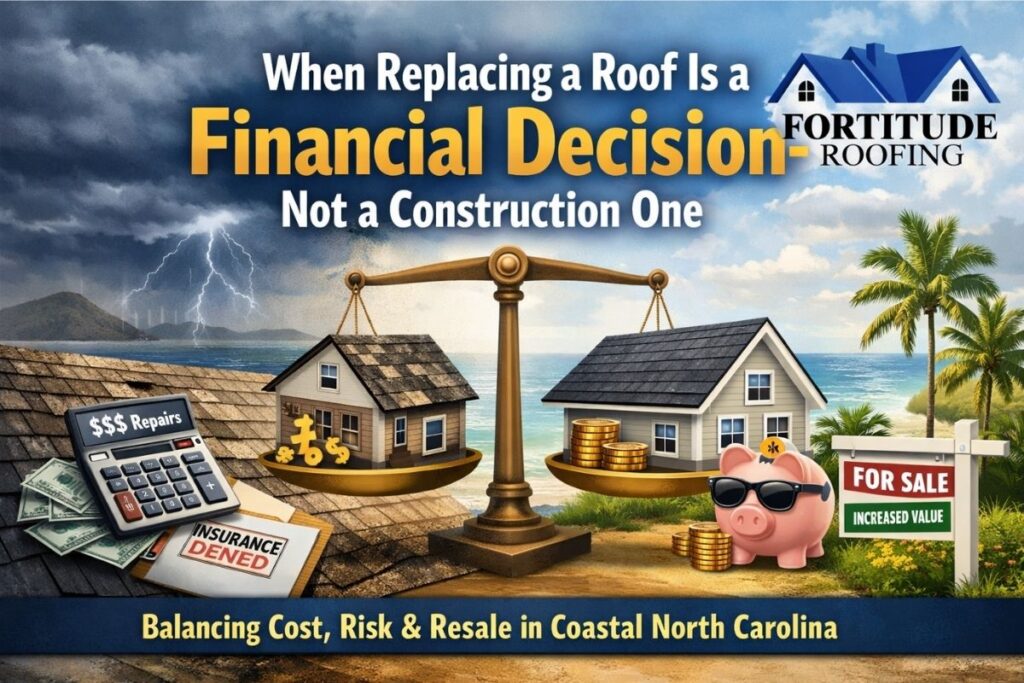
When Replacing a Roof Is a Financial Decision — Not a Construction One
Roof replacement is usually framed as a construction decision: “Is the roof leaking?” “Is it worn out?” “Can it be repaired?” In reality, many replacements happen because the economics shift. The roof may still be functioning, but the financial downside of keeping it becomes larger than the cost of replacing it.
This guide explains the financial drivers that push homeowners toward replacement, how to think about the decision without waiting for a catastrophic failure, and how coastal North Carolina conditions change the risk equation.
Fortitude Roofing serves Carteret, Craven, Onslow, Pender, Brunswick, and New Hanover counties.
Quick Answer: When Is Roof Replacement a Financial Decision?
Roof replacement becomes a financial decision when the expected cost of keeping the roof (repairs, insurance limitations, energy loss, resale friction, and storm exposure risk) exceeds the cost and benefits of replacing it—even if the roof has not catastrophically failed.
The right choice balances performance, risk, and economics—not just current condition.
Why “Condition” Alone Is an Incomplete Decision Framework
A roof can be:
- not leaking today, but highly vulnerable to the next wind event,
- repairable, but expensive to keep patching as failures recur,
- “fine” in appearance, but harming insurability or resale outcomes.
Construction condition answers “Can it function?” Financial framing answers “Is it worth keeping?”
Financial Drivers That Often Justify Replacement
1) Insurance Eligibility and Claim Friction
Insurance economics can force the decision faster than roof failure. Depending on carrier and underwriting posture, older roofs may create:
- reduced eligibility for preferred carriers,
- higher premiums or restricted endorsements,
- limited coverage terms (policy-specific),
- more aggressive “wear and tear” positioning on future storm claims.
Practical implication: If the roof makes your insurance materially more expensive—or makes you less insurable—replacement can be a rational financial move even before leaks begin.
2) The Maintenance Cost Curve (Repairs Start Compounding)
Early in a roof’s life, repairs are rare and cheap. Later, costs rise and frequency increases because:
- seals age and become less reliable after wind cycles,
- flashing and penetrations degrade,
- brittle shingles increase collateral damage during spot repairs,
- small issues become recurring issues.
A useful decision lens is not “How much did I spend this year?” but:
- How often am I paying to touch this roof?
- Is the scope trending up?
If repairs are becoming routine, replacement can be cheaper over a 3–5 year horizon.
3) Energy Efficiency and Attic Performance
Roof replacement can be a financial lever when it allows you to correct system-level inefficiencies, such as:
- inadequate ventilation configuration,
- failed intake/exhaust balance,
- compromised underlayment and air leakage pathways,
- heat gain issues that drive HVAC costs (common in summer-heavy climates).
Important: A new roof isn’t automatically an energy upgrade. The financial value comes from addressing attic/ventilation/assembly performance as part of the project.
4) Resale Timing and Buyer/Inspector Risk
If you plan to sell in the next 12–36 months, the roof can become a negotiation weapon for buyers:
- inspection objections and repair credits,
- financing complications (some lenders/insurers get conservative),
- lower offers to price in perceived risk,
- extended time on market.
Replacing before listing can reduce transaction friction, protect pricing, and simplify negotiations—especially in storm-prone coastal markets where buyers are risk-aware.
5) Risk Exposure: The Cost of Failure Is Not the Cost of Repair
In coastal North Carolina, the biggest hidden cost is often not the repair—it’s the downstream risk:
- interior water damage,
- mold remediation,
- ceiling and insulation replacement,
- emergency tarps and surge pricing after storms,
- deductible exposure and claim complexity,
- disruption (time, stress, temporary relocation risk).
Financially, you’re managing tail risk: low probability events with high cost. Replacing a high-risk roof can be an insurance policy against an expensive failure mode.
When Replacement Makes Sense (Even Without Catastrophic Failure)
Replacement tends to be financially rational when one or more of these are true:
- You’re seeing repeat repairs (the roof is entering the compounding-cost phase).
- The roof is functionally fragile (brittle, seal failures, high vulnerability to wind).
- Insurance options are narrowing or premiums are meaningfully higher due to roof age/condition.
- You plan to sell soon and want to reduce inspection objections and buyer leverage.
- Your home has high exposure (open lots, waterfront, high wind zones, complex roof geometry).
- The “cost of failure” (interior damage + disruption) is unacceptable for your household.
This is less about panic and more about running the numbers with realistic risk assumptions.
A Practical Decision Framework (Simple and Defensible)
Use this 3-part model:
1) Performance
- Is the roof reliably shedding water and resisting wind uplift?
- Are failures isolated or recurring across multiple zones?
2) Risk
- What is your exposure to high-wind events?
- If the roof fails, what is the likely downstream cost (interior damage, disruption)?
3) Economics
- What are you spending annually on repairs and maintenance?
- What is the insurance cost/eligibility impact?
- What resale friction will the roof create?
If performance is declining, risk is high, and economics are trending negative, replacement is no longer a construction decision—it’s a financial one.
What Homeowners Should Do Next
If you want to make this decision cleanly:
- Get an inspection that includes repairability and risk, not just “what’s damaged.”
- Ask for a 3–5 year outlook: expected repair frequency and failure modes.
- Quantify your insurance impact (premium delta, underwriting restrictions, policy limitations).
- Price the replacement correctly (apples-to-apples scope including ventilation and critical details).
- Compare scenarios: “Keep and repair” vs “Replace now” vs “Replace after next storm season.”
The goal is to decide before the roof decides for you.
FAQs
Should I replace my roof if it isn’t leaking?
Sometimes, yes. If insurance eligibility, recurring repair costs, resale timing, or storm-risk exposure make the expected cost of keeping it higher than replacing it, replacement can be financially rational.
How do I know if my roof is in the “compounding repair” phase?
If you’re paying for repairs repeatedly, problems are appearing in new areas, or repairs disturb surrounding brittle materials, the roof may be moving into a higher-cost phase where replacement becomes cheaper over time.
Does a new roof lower homeowners insurance?
It can, depending on carrier and coverage structure. More importantly, it can improve eligibility and reduce underwriting friction. Outcomes vary by policy and market conditions.
Is roof replacement an investment that pays back at resale?
Often it reduces buyer objections and protects pricing, but payoff depends on timing, market conditions, and how the roof risk is perceived in your area.
Final Takeaway
Roof replacement is often framed as construction. In reality, it is frequently financial. The right decision balances performance, risk exposure, and economics—not just current condition. Even without catastrophic failure, replacement can reduce long-term cost when the expected downside of keeping the roof exceeds the cost of replacing it.
Fortitude Roofing Service Area (Coastal NC)
Fortitude Roofing serves homeowners across coastal North Carolina, including Carteret, Craven, Onslow, Pender, Brunswick, and New Hanover counties—such as Wilmington, Hampstead, Surf City, Jacksonville, Morehead City, Beaufort, Emerald Isle, Leland, Southport, and Oak Island.
Author and Review
Reviewed by: Fortitude Roofing (Coastal NC)
Educational content only. Insurance outcomes depend on policy language, endorsements, underwriting criteria, and carrier determinations.