Why Two Roofing Inspections Can Produce Different Conclusions
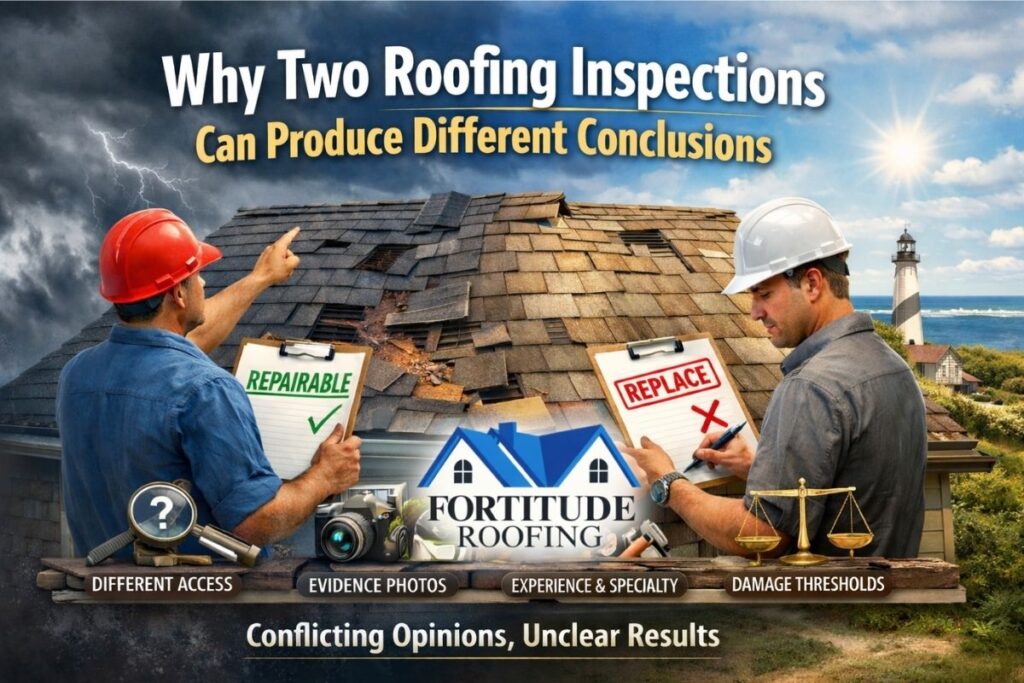
Why Two Roofing Inspections Can Produce Different Conclusions
Conflicting opinions frustrate homeowners. One inspector says the roof is repairable, another recommends replacement. One calls it storm damage, another calls it wear-and-tear. It can feel like someone is guessing—or selling.
In reality, two professional inspections can legitimately differ because a roof evaluation is diagnostic, not binary. Inspectors may be working with different access, different scopes, different standards, and different thresholds for what constitutes functional damage versus cosmetic wear.
This guide explains the most common variables that create different conclusions and what homeowners in coastal North Carolina should do to reach a defensible decision.
Fortitude Roofing serves Carteret, Craven, Onslow, Pender, Brunswick, and New Hanover counties.
Quick Answer: Why Do Two Roof Inspections Produce Different Results?
Two roof inspections can produce different conclusions because inspectors may differ in:
- inspection scope (what they were asked to evaluate),
- access and visibility (what they could physically inspect),
- experience and specialization (storm damage, installation defects, leaks, etc.),
- damage interpretation thresholds (what they consider functionally damaged),
- and documentation quality (how well they prove the findings).
Different conclusions do not automatically mean anyone is dishonest. They often mean the roof requires a clearer diagnostic framework and better evidence.
Roof Inspection Variables That Commonly Drive Conflicting Conclusions
1) Inspection Scope: What Question Was the Inspector Answering?
Not all inspections are the same. The conclusion depends heavily on what the inspector was asked to determine, for example:
- “Is the roof leaking and why?”
- “Is there storm damage consistent with a recent event?”
- “Is this roof repairable to pre-loss condition for insurance purposes?”
- “How much remaining service life is left?”
- “Is the installation compliant with manufacturer requirements?”
If two inspectors are answering different questions, they can both be “right” and still disagree.
2) Access Limitations: What Could They Actually See?
Roofing is constrained by visibility and safety. Differences arise when:
- one inspector walked the roof and another did a ground-level evaluation,
- slopes were too steep or unsafe to traverse,
- weather conditions limited inspection time or surface assessment,
- attic access was not available (leak tracing and ventilation evaluation suffer),
- drone imagery was used by one inspector but not the other.
If one person had materially better access, their findings may be more reliable—especially for subtle wind damage, seal failures, or small punctures.
3) Experience Level and Specialty: What Patterns Do They Recognize?
Experience matters, but so does domain focus. Inspectors may specialize in:
- wind/hail event documentation,
- leak diagnostics and moisture tracing,
- installation defects and manufacturer compliance,
- older roof systems and material behavior,
- coastal exposure patterns (salt, wind cycling, UV degradation).
Two inspectors can look at the same roof and emphasize different failure mechanisms based on what they’ve seen repeatedly in the field.
4) Damage Interpretation Thresholds: What Counts as “Damage”?
This is a major source of disagreement—especially in insurance-adjacent contexts.
Inspectors may differ on:
- whether a crease is a functional break or a superficial wrinkle,
- whether a lifted tab is a temporary displacement or a compromised seal,
- whether granular loss is normal aging or impact-related,
- whether brittleness creates an unacceptable repair risk,
- whether conditions are “cosmetic,” “maintenance,” or “storm-related.”
The roof doesn’t just need “damage.” It needs damage that affects performance, repairability, or pre-loss restoration (depending on the purpose of the inspection).
5) Timing and Event Context: What Changed Between Inspections?
A roof can change in a short period:
- additional wind events lift and reseat tabs,
- temporary repairs mask conditions,
- moisture migrates and shows up later,
- sun heat can reseal some shingles and hide prior lifting,
- foot traffic during inspection can disturb brittle shingles.
If inspections were separated by weeks or months, it is possible the roof condition genuinely evolved.
6) Documentation Standards: What Can Be Proven?
A conclusion is only as strong as the evidence behind it. Two inspectors may have different outcomes because:
- one produced a slope-by-slope photo set and the other did not,
- one documented functional indicators (seal failure, creases, fastener back-out) and the other gave general statements,
- one included attic/mold/moisture indicators and the other did not,
- one tied findings to repair feasibility, while the other offered only a recommendation.
In disputes, the best-documented inspection usually carries more weight.
Why This Is Normal: Roof Evaluation Is Diagnostic, Not Binary
Roof systems fail in ways that are incremental, conditional, and dependent on exposure. Two reasonable professionals can disagree because they are interpreting probabilities:
- probability of near-term leak,
- probability a repair will hold under future wind cycles,
- probability the roof can be restored to pre-loss condition without creating failure points.
This is why the right next step is rarely “pick the opinion you like.” It’s to refine the diagnostic inputs.
What Homeowners Should Do When Inspections Conflict
If you have two different conclusions, don’t rush. Use a structured approach to force clarity:
- Confirm the question being answered
Ask each inspector: “What was the purpose of your inspection—leak diagnosis, storm damage assessment, repairability, remaining life, or all of the above?” - Standardize access and methods
Request a roof walk (if safe), attic check (if relevant), and slope-by-slope documentation. If one inspection was ground-only, consider that a preliminary opinion. - Ask for a slope-by-slope evidence package
Require wide shots + close-ups, labeled by slope/facet, with a summary that ties evidence to conclusions. - Separate observations from conclusions
You want: (a) what was observed, (b) what it implies, (c) what the recommended scope is, and (d) why. - Pressure-test repairability (if insurance is involved)
Ask: “Can this be repaired to pre-loss condition without collateral damage, mismatching, or high-risk transitions?” - Escalate to a deeper evaluation when needed
For high-stakes decisions, request a more comprehensive inspection format (sometimes including moisture mapping or third-party engineering, depending on context).
A credible contractor should be able to explain differences in a calm, technical manner and tighten the decision with better documentation.
FAQs
Does a different conclusion mean one inspector is lying?
Not necessarily. Different conclusions often come from different scope, access, experience, or thresholds for what qualifies as functional damage.
Is a ground inspection as reliable as walking the roof?
It can identify obvious issues, but it often misses subtle wind damage, seal failures, and small punctures—especially on complex roofs. A roof walk typically produces a more defensible result when it can be done safely.
Why do some inspectors call damage “wear and tear” and others call it “storm damage”?
Because interpretation thresholds vary and the evidence can be ambiguous. The most reliable evaluations document slope-by-slope indicators and tie them to performance and repair feasibility.
What should I ask for to settle conflicting opinions?
A standardized, slope-by-slope photo set, clear notes tied to each slope, and a written explanation of why the roof is or isn’t reasonably repairable (if insurance is part of the decision).
Final Takeaway
Conflicting roof inspection conclusions should prompt deeper evaluation—not rushed decisions. Roof evaluation is diagnostic, and differences often arise from scope, access, experience, and interpretation thresholds. The fastest path to clarity is standardized access, stronger documentation, and a clear definition of what question the inspection is answering.
Fortitude Roofing Service Area (Coastal NC)
Fortitude Roofing serves homeowners across coastal North Carolina, including Carteret, Craven, Onslow, Pender, Brunswick, and New Hanover counties—such as Wilmington, Hampstead, Surf City, Jacksonville, Morehead City, Beaufort, Leland, Southport, and Oak Island.
Author and Review
Reviewed by: Fortitude Roofing (Coastal NC)
Educational content only. Coverage decisions depend on policy language, endorsements, and carrier determinations.